
Skip to content
Scan a barcode
Scan
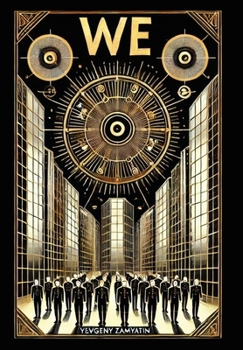
Hardcover We (Collector's Edition) (Laminated Hardback with Jacket) Book

ISBN: 1998621987

ISBN13: 9781998621989

We (Collector's Edition) (Laminated Hardback with Jacket)

Select Format

Select Condition ThriftBooks Help Icon

Recommended

Format: Hardcover

Condition: New

$39.99
50 Available
Ships within 2-3 days

Book Overview

Collector's Edition Laminated Hardback with Jacket

We is a groundbreaking dystopian novel set in the One State, a future society where citizens live in glass buildings under constant surveillance and follow a life governed by logic and precision. D-503, an engineer loyal to the state, begins to question his beliefs after meeting the subversive I-330, sparking inner conflict between his loyalty to the state and his yearning for freedom. Through D-503's journey, the novel explores themes of individuality, control, and the human spirit against an oppressive, logic-driven society.

We by Yevgeny Zamyatin holds a significant place in literary history as one of the earliest dystopian novels, influencing later classics like 1984 by George Orwell and Brave New World by Aldous Huxley. Written in 1920, We was the first novel banned by the Soviet censorship board, illustrating Zamyatin's bold critique of totalitarianism and the dangers of an overly controlled society. Its portrayal of an oppressive regime, constant surveillance, and the suppression of individuality provides a powerful cautionary tale that resonated with readers and writers under repressive regimes throughout the 20th century, establishing We as a foundational work in the dystopian genre.

Customer Reviews

6 ratings

Our future?

I read it at russian high school. That day we didnot believe that we will live like people in that book-)))

One of the first, and one of the most interesting versions of a dystopia

The concept of a dystopia in literature has been done over and over again to an extent that we know the basic framework. 1984 has burned the image of it in our heads, and it's hard to escape it even decades divorced from Orwell's work. However, for those who want some dystopia that has a bit of variety, there are some options. And while you can list options like Huxley or Brunner, I'd put Zamyatin's We at the top of that list. Beyond the simple fact of "its the book that inspired Orwell in the first place". We works by taking the same basic formula and twisting it. Rather than an outsider looking upon the dystopia, it's a person who doesn't realize the extent of the dystopia he's in. An insider looking outward, seeing the world that he is so used to for what it is rather than what he's known. The idea itself is interesting, and the way that Zamyatin relays the information on this world and everything in it is impressive. He writes not from the character's perspective very well, melding D-053's mathematically formulaic views into every detail to an extent that's impressive. The prose he cooks up to explain something as simple as a person smiling is one I've never seen done before, and one that makes too much sense to not be worthy of praise. I will admit the book's prose can become a tad of a detriment and you will have to trace back and re-read sections to fully grasp what Zamyatin is doing, but We is well worth a read.

Wonderful book and physical quality!

The translation from Russian is superb, and the overall quality of the book is excellent.

We

The label "forgotten classic" is overused, but it definitely applies to We, a dystopian novel written in 1921 by Yevgeny Zamyatin, a Russian author who would soon disappear into exile and obscurity as a result of his work. We is a precursor to Brave New World and Nineteen Eighty-four, but in my opinion it is the most powerful and most perfect of the three. The story is told by D-503, a male mathematician in a society organized on the principles of mathematics. The setting is centuries in our future, long after a war has reduced the human population to a few millions and led to the formation of One State, a single enclosed city-state. The guiding principle of One State is that freedom is unhappiness. To ensure uniformity, all buildings, including private dwellings, are made of glass so there is no privacy. The people (called "ciphers") all rise at the same moment, eat together, and take exercise by marching in formation. The true nightmare of We is not its grim picture of society, but the fact that so many of the ciphers, D-503 included, find it a delightful way to live. There are exceptions, however, including the seductive and mysterious I-330 with whom D-503 falls in love. Such attachments are, of course, forbidden, and D-503 is in anguish over his inability to control his feelings. The style in which We is written is unique and adds substantially to its appeal. D-503, as noted, is a mathematician, and his memoirs rely heavily on the language and metaphors of mathematics. At times, however, it is an outpouring of emotion from someone utterly unused even to the concept of emotions, much less the experience. We, as one might expect, is a satire against the totalitarian excesses of the new Soviet regime. Both a Communist and a Russian patriot, Zamyatin was astute enough even as early as 1921 to see that the revolution was leading in a direction away from the desires of many of its proponents. But the novel is also a powerful, even shocking statement about out concepts of happiness and freedom.

Best of Dystopian Trilogy

Zamyatin's WE, like Huxley's Brave New World and Orwell's 1984, is a classic science-fiction novel that unmasks the chilling realities of the erosion of individuality. What makes Zamyatin's account more compelling, however, is that he wrote the novel from within the fledgeling Socialist state of 1920's Russia (it wasn't even published there until 1988). Therefore, Zamyatin can lay claim to a firsthand understanding of the fallacies of the Soviet collective unlike the eccentric British intellectuals Orwell and Huxley. Although Zamyatin's language, at times, is a bit peculiar by nature, this Twentieth Century Classics translation is perhaps the easiest to understand, as the translator shied away from word use that would not register smoothly in the mind of a contemporary English reader. If you have read Brave New World or 1984, you will certainly want to compliment them by reading this excellent masterpiece in 20th century European literature!

"Only the unsubduable can be loved"

This novel (the edition I read was a translation from the Russian by Mirra Ginsberg in 1972) is an excellent satire by Yevgeny Zamiatin (or, Zamyatin). Reading it, I find it remarkable that Zamiatin was not sent to Siberia or executed in one of the many purges occurring in the Soviet Union at that time. Apparently, the book was never published in the Soviet Union. It appeared first in English in 1924 (and obviously had a major influence in the development of Orwell's "Nineteen Eighty-Four") and then in Czech in 1927. The Soviet authorities began to put pressure on the author through the Writers' Union and, probably due to the help of Maxim Gorky, Zamiatin was allowed to leave for Paris in 1931 (he died in Paris in 1937). The story is an extrapolation of a totalitarian world. The population of Earth that have survived a 200-years war find themselves members of a single state (the One State) where imagination is considered a disease. In this society the individual does not count, only the multitude. The central character is D-503 (all the inhabitants are numbers in this State), a mathematician who is building a space ship to bring their "perfect" world and culture to others. The whole novel consists of D-503's journal. However, D-503 soon meets I-330, a woman who shows him that there are numbers in the One State that feel that the State is in error and are striving for a new revolution. He begins to have strong feelings for her. He thinks he is ill but he can't help himself. And, he must keep his feelings hidden from the Guardians, the One State's "protectors." What a terrific "read." I highly recommend it (as well as "1984" and "Brave New World"). As can be seen in the comments by the other reviewers, "We" is a great book to discuss: with respect to politics, history, science fiction, or literature.
Copyright © 2026 Thriftbooks.com Terms of Use | Privacy Policy | Do Not Sell/Share My Personal Information | Cookie Policy | Cookie Preferences | Accessibility Statement
ThriftBooks® and the ThriftBooks® logo are registered trademarks of Thrift Books Global, LLC

GoDaddy Verified and Secured