





Book Overview
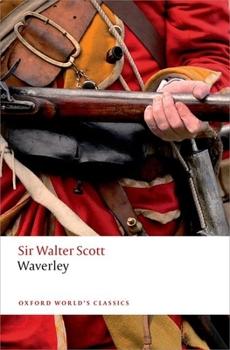
"The most romantic parts of this narrative are precisely those which have a foundation in fact." Edward Waverley, a young English soldier in the Hanoverian army, is sent to Scotland where he finds himself caught up in events that quickly transform from the stuff of romance into nightmare. His character is fashioned through his experience of the Jacobite rising of 1745-6, the last civil war fought on British soil and the unsuccessful attempt to reinstate the Stuart monarchy, represented by Prince Charles Edward. Waverley's love for the spirited Flora MacIvor and his romantic nature increasingly pull him towards the Jacobite cause, and test his loyalty to the utmost. With Waverley, Scott invented the historical novel in its modern form and profoundly influenced the development of the European and American novel for a century at least. Waverley asks the reader to consider how history is shaped, who owns it, and what it means to live in it - questions as vital at the beginning of the twenty-first century as the nineteenth. ABOUT THE SERIES:
For over 100 years Oxford World's Classics has made available the widest range of literature from around the globe. Each affordable volume reflects Oxford's commitment to scholarship, providing the most accurate text plus a wealth of other valuable features, including expert introductions by leading authorities, helpful notes to clarify the text, up-to-date bibliographies for further study, and much more.
For over 100 years Oxford World's Classics has made available the widest range of literature from around the globe. Each affordable volume reflects Oxford's commitment to scholarship, providing the most accurate text plus a wealth of other valuable features, including expert introductions by leading authorities, helpful notes to clarify the text, up-to-date bibliographies for further study, and much more.
Format:Paperback
Language:English
ISBN:0198716591
ISBN13:9780198716594
Release Date:June 2015
Publisher:Oxford University Press
Length:544 Pages
Weight:0.85 lbs.
Dimensions:0.9" x 5.0" x 7.6"
Customer Reviews
2 ratings
WAVERLEY: THE FIRST HISTORICAL NOVEL, THE FIRST POLITICAL NOVEL
Published by Thriftbooks.com User , 19 years ago
Sir Walter Scott began WAVERLEY, his first novel, in 1805. Years later, after his move to his dream home Abbotsford near the border with England, he found his manuscript while rummaging in a fishing tackle box. He then brought the world's first historical novel to a conclusion in 1814. Abe Lincoln read Walter Scott. His children entertained their mother re-enacting scenes from the WAVERLEY series of novels. I wonder therefore if Lincoln's "Four score and seven years ago..." does not echo WAVERLEY's frequently repeated sub-title, " 'Tis Sixty Years Since." WAVERLEY is narrated as from 1805, the year it was begun, and for both it and the Gettysburg Address, a reader inevitably starts calculating backwards. What date are we talking about? Ah,1745 for young Edward Waverley. We know (as he does not) what turmoil he is letting himself in for when he rides into the Highlands -- the last hurrah of the legitimate Stuart dynasty. And 1776 for Abe Lincoln meant the Declaration of Independence. In 1745 "auld" Scotland almost disappeared in defeat. In 1776 Hanoverian Britain began its retreat from North America. Scott tells us in i.1 (p. 5) that in 1745 our ancestors expressed their anger directly, by taking up arms. But in 1805/1814 his generation was more indirect, taking enemies to court. This very great novel should be read for sheer entertainment, for its characters, for the omnipresent black bears of the Baron of Bradwardine and for its love story. But I suggest that we read it as well as history and geography. Are we up for the sounds of broad Scots language? For a smidgen of Highland Gaelic (which Scott barely knew)? To learn about doch and dorroch and the stirrup-cup? Through hundreds of details of what Scotsmen ate, how they dressed, how beautiful were their mountains and waters near Perth, Walter Scott brought Scotland to life in England and throughout Europe and in the USA. WAVERLEY makes us take Scotland, the real Scotland of history, seriously. We see its educated Catholic Highlanders sending their children to study in France and Italy. Bonnie Prince Charlie lost only one battle of several, but it was enough to secure Hanoverians their throne. We sense that the transition, however awful, was inevitable from fiercely independent Scotland to an uncomfortable, demoted "North Britain" within a prospering, peaceful United Kingdom of middle-class shopkeepers. Walter Scott makes us ask what if any history has to teach us. Not only is WAVERLEY the first historical novel. It is also the first political novel. We see dimly how a generally dismal set of rulers, the Stuart dynasty, could continue to win men's loyalty to a lost cause. In a later novel, also about Prince Charlie 20 years later, we read of a Scottish family named REDGAUNTLET whose fate was always to be on the losing side. What makes subjects or citizens alike glory in losing for political principle? Mark Twain wrote as if all Walter Scott cared about were kings and dynasties, knights,
An Adventure in Scotland! How can you go wrong??
Published by Thriftbooks.com User , 25 years ago
With Waverly, Sir Walter Scott virtually invented the historical novel. The story is based around mostly fictional characters that participate in the Jacobite uprising in 1745 in Scotland. It's also the story of friendships, courage, divided loyalties and of course love. Edward Waverly, the hero gets unwittingly caught up and swept along in a marvelous drama in which he comes of age. As the book progressed I also found myself getting more caught up in the novel and its characters. For me, that's the mark of a very good book.Both the author and editor's notes were very helpful and I used them often.Enjoy!
Copyright © 2026 Thriftbooks.com Terms of Use
| Privacy Policy | Do Not
Sell/Share My Personal Information | Cookie Policy | Cookie Preferences | Accessibility Statement
ThriftBooks® and the ThriftBooks® logo are registered trademarks of Thrift Books Global, LLC
ThriftBooks® and the ThriftBooks® logo are registered trademarks of Thrift Books Global, LLC
