


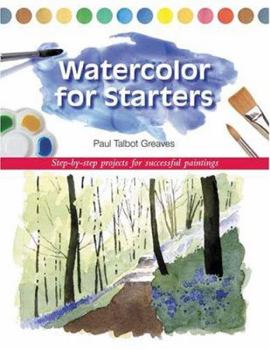
Watercolor for Starters: Step-By-Step Projects For Successful Paintings


Select Format
Select Condition 
Book Overview
This book contains all the know-how the first-time painter needs to create finished paintings. All the most important aspects of watercolour painting are explained in easy-to-understand exercises, including colour theory, brush strokes, tone, composition and perspective. Popular landscape subjects are broken down into achievable step-by-step exercises to help develop the reader's understanding. Also included are traceable templates for each of the projects, ensuring that the reader really can just pick up this book and paint a finished picture straight away.
Format:Paperback
Language:English
ISBN:0715321854
ISBN13:9780715321850
Release Date:September 2005
Publisher:David & Charles Publishers
Length:128 Pages
Weight:1.21 lbs.
Dimensions:11.0" x 0.3" x 8.5"
Customer Reviews
3 ratings
great Service!
Published by Thriftbooks.com User , 17 years ago
I received Watercolor For starters in record time and the book is in excellent condition. What more can a book buyer ask for? Now its onto the brushes and paint ... patricia
Love it!
Published by Thriftbooks.com User , 17 years ago
Great for a beginner to intermediate painter. I enjoy his color selection and style of painting. He is clear and complete in his instruction for the demonstrations, etc. I highly recommend it!
Gentle intro to a demanding medium
Published by Thriftbooks.com User , 20 years ago
Watercolor, among all painting media, may be the easiest to start and the most difficult to master. Children so often begin with it, in those little pans of dried colors, but virtuosos like Beatrix Potter show how just how far the medium can be taken. This book is for anyone starting out on that long road to mastery. Talbot-Greaves starts with the basics: "Watercolor is transparent ... You can not paint a light tone on top of a dark tone." Although this fact gives watercolor its brilliance, it also creates the greatest challenges in using the medium. After explaining the basics, the author discusses the paints themselves, in their various grades, paper, brushes (including what to avoid), and other basics including masking materials. Although he describes the different weights and surfaces of available paper, I was disappointed at how little he explained the paper's role in the finished product. Yes, the surface affects how paint will flow. The hefty substance of watercolor paper is important, also: it not only resists cockling after lengthy contact with water, it also retains the strength needed to support aggressive techniques and rework in its wet state. His discussion of color-mixing is very brief; it should be supplemented by your favorite auxiliary text. Before he even gets into colors and mixing, Talbot-Greaves has the reader started on exercises in flat and gradient washes - the most basic of watercolor techniques, and the ones that differ most from painting with viscous media like oils, tempera, gouache, or acrylic. He then shows other brush techniques, and demonstrates how to "read" the use of each technique in a finished painting. (Talbot-Greaves is a pragmatist, by the way, and un-fussy about selective use of opaque white where it can help.) Sections on color and color mixing, composition, and perspective are brief - they'd just get in the way of putting paint to paper, which is Talbot-Greaves's real goal. I would have hoped for a little more time spent on color and mixing, so I hope you'll supplement this overly-brief discussion with another text. Instead of a general discussion of available colors and their individual characteristics, Talbot-Greaves plunges directly into projects of graded difficulty and specifies the colors to use for each. This may be a surpise to some students: seeing how much versatility there is in just a small selection of colors. Even complex images get by nicely on a limited palette - you don't need every color every time. Each project addresses specific skills, from basic washes up to the many approaches needed for creating complex textures. The final section of the book supports these lessons by showing the photos and initial sketches behind each project. The author encourages the student to copy these skeletal templates. This is not to quash creativity, but to let students skip over compositional problems on the way to getting their hands constructively dirty. Like any other instructional book (and
Copyright © 2026 Thriftbooks.com
Terms of Use | Privacy Policy | Do Not Sell/Share My Personal Information | Cookie Policy | Cookie Preferences | Accessibility Statement
ThriftBooks ® and the ThriftBooks ® logo are registered trademarks of Thrift Books Global, LLC
ThriftBooks ® and the ThriftBooks ® logo are registered trademarks of Thrift Books Global, LLC
