


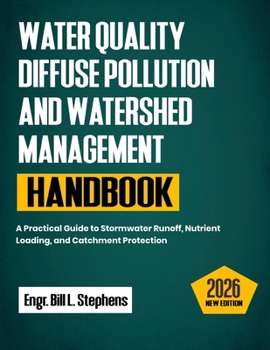
Water Quality Diffuse Pollution and Watershed Management Handbook: A Practical Guide to Stormwater Runoff, Nutrient Loading, and Catchment Protection
No Customer Reviews

Why does a stream still fail its standards after fifteen years of practice work? Why do two consultants hand you load estimates that differ by a factor of three, using the same data? Diffuse pollution is not hard because the science is obscure. It is hard because the load arrives in a handful of storms, the sources are invisible on a land use map, and the arithmetic everyone trusts quietly overstates what a programme can deliver. Inside, you will gain the ability to: Walk into an unfamiliar catchment and know within one field season where the load is coming from, instead of spending three years finding outDefend your load estimate when a reviewer challenges it, and catch the errors buried in someone else's numbers before you put your name to themStop funding measures that cannot physically remove the pollutant you are listed for, and redirect that money to something that canSize a basin, a bioretention cell, or an infiltration trench to a procedure that passes review the first timeLook at an eroding bank and know whether a treatment will hold or be undermined within four wintersCommit to a reduction figure your programme will actually achieve, so you are funded for a second decade instead of reported as a failure
Each method is presented the way you will actually use it: the relationship, a complete worked example, the error that most often goes undetected, and the conditions under which the method should not be applied at all. Reference tables, field forms, and inspection checklists are gathered in the appendices for direct use in the field. Scroll up and get your copy today.
Each method is presented the way you will actually use it: the relationship, a complete worked example, the error that most often goes undetected, and the conditions under which the method should not be applied at all. Reference tables, field forms, and inspection checklists are gathered in the appendices for direct use in the field. Scroll up and get your copy today.
Format:Paperback
Language:English
ISBN:B0HHDLJP46
ISBN13:9798171119454
Release Date:September 2026
Publisher:Independently Published
Length:540 Pages
Weight:2.72 lbs.
Dimensions:1.1" x 8.5" x 11.0"
Customer Reviews
0 rating
Copyright © 2026 Thriftbooks.com
Terms of Use | Privacy Policy | Do Not Sell/Share My Personal Information | Cookie Notice | Cookie Preferences | Accessibility Statement
ThriftBooks ® and the ThriftBooks ® logo are registered trademarks of Thrift Books Global, LLC
ThriftBooks ® and the ThriftBooks ® logo are registered trademarks of Thrift Books Global, LLC
