


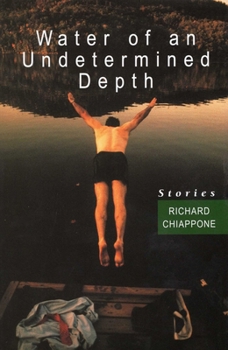
Water of an Undetermined Depth

Select Format
Select Condition 
Book Overview
What's a man to do when his life is just work and trouble? Some hunt, some fish, some drink, some gamble. Richard Chiappone writes about them all--men living their lives, doing what they have to, and getting through the day. These characters are real, gritty, imperfect working men, who make the wrong choices and mess up. These stories about real people, tough and resilient, making hard choices, are a powerful and inspiring collection.
Format:Hardcover
Language:English
ISBN:081170033X
ISBN13:9780811700337
Release Date:December 2002
Publisher:Stackpole Books
Length:144 Pages
Weight:0.84 lbs.
Dimensions:0.7" x 6.3" x 9.5"
Customer Reviews
1 rating
Stories That Swim in the Deep End
Published by Thriftbooks.com User , 18 years ago
The fact that Richard Chiappone shares the same initials as the godfather of modern short fiction is pure coincidence. The fact that Chiappone's stories in Water of an Undetermined Depth punch readers in the gut with the same five-knuckled force Raymond Carver used in his fiction is perhaps less surprising. The characters in these fourteen tales, nearly all of them down on their luck blue-collar guys, could have stepped straight from the pages of Will You Please Be Quiet, Please? without even bumping the ash off their cigarettes. Carver's ghost haunts every page of Water of an Undetermined Depth. Comparing contemporary writers to Carver is an safe avenue for reviewers to take when trying to describe a book's tone (Tense. Gritty. Genuine.), and I'll admit I'm about to go down Easy Street; but we have to start somewhere. Hell, when Geoffrey Wolff reviewed Carver's first book, he compared him to guys like Harold Pinter, Thomas Pynchon and Franz Kafka. I'm only surprised Wolff didn't mention Hemingway as well. Carver called Papa H. "a marvelous writer" and once said, "There was something about the cadence of those sentences that excited me." There was always something about Carver's cadences that gave me a blood rush, an excitement generated from the page to the eye to the brain to the heart in the space of an eyeblink. It was like the joy of seeing new terrain for the first time, the way he formed his valleys and mountain ranges across the span of sentences. It's a joy I haven't felt in a long time. Not until I picked up Chiappone's book, that is, and started reading his first story, "The Chubs," about a college student who ditches class to go fishing in creeks trickling past the town's chemical plants. The story, set in upstate New York, hooked me like a perfectly-tied Royal Wulff when I read sentences like these: I could look out the mouth of the creek and down the big river and see the Chevy plant, and I was appalled. I swore that my life would never revolve in such a grubby little orbit, that my future would be different, special somehow. I think I believed that. The boy's father startles him one day by skipping work at the chlorine gas plant to go fishing with him at the polluted creek. As his father drifts aimlessly through mid-life depression, the boy imagines his own future. But what I could not see was myself...ten years down the road with a wife and children and none of the skills needed to support us. What I couldn't see were the layoffs and cutbacks and plant closings, the lines at the unemployment office stretching down Pine Avenue and around the corner, the past-due bills, the loans unpaid, the credit cards full and the checkbook empty. What I couldn't see was the journey back and forth across the continent in search of work, and a marriage collapsing as love gave way to shame and blame and the sure death of affection that goes with that whole life. What I couldn't see was me going to my father with my hand out
Copyright © 2026 Thriftbooks.com Terms of Use
| Privacy Policy | Do Not
Sell/Share My Personal Information | Cookie Policy | Cookie Preferences | Accessibility Statement
ThriftBooks® and the ThriftBooks® logo are registered trademarks of Thrift Books Global, LLC
ThriftBooks® and the ThriftBooks® logo are registered trademarks of Thrift Books Global, LLC
