


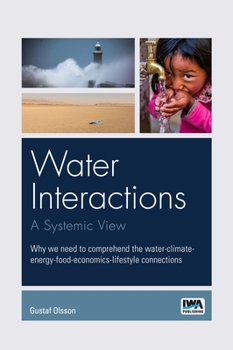
Water Interactions: A Systemic View: Why We Need to Comprehend the Water-Climate-Energy-Food-Economics-Lifestyle Connections
No Customer Reviews

During the last two decades, the interrelationship between water and energy has become recognized. Likewise, the couplings to food and agriculture are getting increasingly obvious and alarming. In the last year, a record number of extreme weather events have been reported from most parts of the world. This is a visible demonstration how consequences of climate change must be understood and alleviated. The impacts of economics, lifestyle, and alarming inequalities are becoming increasingly recognisable. If the wealthy part of the world is not willing not make radical changes it does not matter what the less wealthy half of the global population will do to meet the climate and resource crisis. The purpose of the book is to demonstrate and describe how climate change, water, energy, food, and lifestyle are closely depending on each other. It is not sufficient to handle one discipline isolated from the others. This is the traditional "component view". The book defines and describes a systems view. The communications and relationships between the "components" have to be described and recognized. Consequently, the development of one discipline must be approached from a systems perspective. At the same time, the success of the systems perspective depends on the degree of knowledge of the individual parts or disciplines. The catchphrase of systems thinking has been caught in the phrase, "The whole is more than the sum of its parts". The idea is not new: the origin of this phrase is to be found already in Aristotle's Metaphysics more than 2300 years ago. The text may serve as an academic text (in engineering, economics, and environmental science) to introduce senior undergraduate and graduate students into systems thinking. Too often education encourages a "silo" thinking. Current global challenges can't be solved in isolation; they depend on each other. For example, water professionals should have a basic understanding of energy issues. Energy professionals ought to understand the dependency on water. Economic students should learn more how economy depends on natural resources like energy and water. Economics must include the environmental impact and ecological ceiling of economic activities.
Format:Paperback
Language:English
ISBN:1789062896
ISBN13:9781789062892
Release Date:August 2022
Publisher:IWA Publishing (Intl Water Assoc)
Length:140 Pages
Related Subjects
Engineering Science Science & Math Science & Scientists Science & Technology TechnologyCustomer Reviews
0 rating
Copyright © 2026 Thriftbooks.com
Terms of Use | Privacy Policy | Do Not Sell/Share My Personal Information | Cookie Notice | Cookie Preferences | Accessibility Statement
ThriftBooks ® and the ThriftBooks ® logo are registered trademarks of Thrift Books Global, LLC
ThriftBooks ® and the ThriftBooks ® logo are registered trademarks of Thrift Books Global, LLC
