


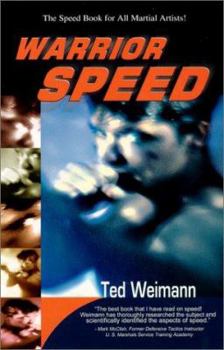
Warrior Speed

This is the definitive reference on speed training for martial artists. Author Ted Weimann has done exhaustive research on the physiology, kinesiology, and psychology of speed to bring you the most... This description may be from another edition of this product.
Format:Paperback
Language:English
ISBN:1880336383
ISBN13:9781880336380
Release Date:September 2000
Publisher:Turtle Pr
Length:8 Pages
Weight:1.04 lbs.
Dimensions:6.0" x 1.0" x 8.8"
Customer Reviews
5 ratings
This book is great
Published by Thriftbooks.com User , 22 years ago
Weimann has filled his book with a variety of basic principles and concrete examples of a handful of exercises for improving speed in martial arts. Many parts of this book would be useful in almost any athletic endeavor, and many of the studies cited are on performance in things like weightlifting, running, swimming, and cycling.If you are looking for simply a series of drills and exercises, then this isn't the book for you. If you are looking to really understand the physics, physiology and pyschology of althetic performance, then this is an excellent text. It may be dry to some readers as it sometimes reads like a scientific review article, but I found the references to research extremely helpful and enlightening. I am a bit more skeptical of some of the psychological drills, but the mind is a complicated thing.I found a lot of good information in this book that I haven't encountered in other exercise/fitness books, such as why you should take Tylenol for muscle aches but not Alleve (the answer is on page 61) if you want to gain muscle mass.The only complaints I have are with the title and the binding which doesn't open flat. The title is kind of cheesy. A good description, although very pedantic would be something like: "A Review of Current Research in Developing Speed in Athletic Performance and Suggested Applications of These Principles to Training".
Very Helpful
Published by Thriftbooks.com User , 22 years ago
I practice Kenpo, and have been studying for about four years now. I'm not the best, and I'm certainly not the fastest. After reading Warrior Speed, I'm still not the best nor the fastest, but it did help me to overcome a plateau that hit about four months ago, and I have improved a good deal.
very good stuff..
Published by Thriftbooks.com User , 22 years ago
The author has done his homework. After reading the first couple of chapters, I now understand the muscular system in great detail and understand how it can be improved or impaired through training. The physiological info provided is remarkable and worth studying if you are involved in any sort of sport where speed & power are factors- but especially martial arts. Plyometrics are covered very clearly (and scientifically) and sample exercises are given. The author looks at what supplements & drugs are out there and summarizes their effects very well. Speed itself is broken down as it applies to martial arts, and focus is placed on the areas that can be significantly improved through training.This is a no-BS book that I've been impressed with so far, and with every page I read I think "wow, that's good to know." The information is presented in a way that really gives martial arts folks exactly what they care about, without drifting too far into other topics. Lots of numbers- for example, a typical punch's force comes from 39% legs, 37% trunk, and 24% arms. Maybe its just me, but I love numbers.As a side note I had just been reading Bruce Lee's "Tao of Jeet Kune Do" and I find that much of the information here complements Lee's writings.. much of it actually is more detailed and scientifically based than Lee's. The author has much more scientifc data available at the time of writing than Lee did, of course, and he has really taken advantage of it.Two thumbs up- this is really informative and should be considered a "must read" for martial arts practitioners who are serious about developing speed.
A note from the author.
Published by Thriftbooks.com User , 25 years ago
My goal in writing Warrior Speed was to write the most thorough, scientifically based book ever written on the topic. I believe I have accomplished that goal and I feel confident enough to say I know you'll agree. Allow me to explain some of the research that went into this book. Prior to taking on this project of writing Warrior Speed, my background consisted of over 20 years training in the martial arts. I have also had the privilege of training under very knowledgeable athletic coaches in gymnastics, track and boxing. Warrior Speed is composed of 19 chapters and it took 3 full years to complete. I studied physics and interviewed experts in the field so that I could dissect and explain how physics effects fighting speed. As far as making yourself actually move faster via muscular contractions, I reviewed thousands of research articles on exercise physiology. This research included visiting several medical libraries and joining numerous medical associations. The information contained within chapters 2 and 3 could be used by coaches and trainers of professional teams and Olympic athletes to ensure that their training programs incorporate the latest scientific knowledge. As with other parts of the book, the chapters on psychology draw from personal experience and the experience of the instructors I have had the privilege of training under. After thoroughly researching the field, including interviewing a Dr. of psychology at the Olympic Training facility in Colorado, I developed a mental training regimen based on the program designed by Dr. Garfield. Dr. Garfield is a leading trainer in the area of peak athletic performance. I found his program to be the most effective and best supported by research. I hope you'll agree.The chapter on Perception Speed is one of my favorite chapters because it teaches you how to perceive the actions of your opponent before he initiates them. The chapter on Deception Speed is one of my favorites to practice while sparring because of all the little tricks you can play on your opponent. I had a lot of fun writing those chapters and I enjoy reviewing them from time to time. That brings up a good point. Warrior Speed is not an exciting book to read. I believe that most of it is very interesting, but it is a TEXT book. You will want to use it as a training manual and reference. I have highlighted my copy so that I may review some of the more complex topics more efficiently. I hope you believe this book worthy of doing the same. Thank you for taking the time to read my note. I hope it helps.Note: on the chapters that compare the speed of various techniques, electronic equipment was used to measure the speed and slow motion cameras were employed to study the movements. It is possible however, that after thorough practice of the techniques, you may still disagree with one of the results published in Warrior Speed. That discrepancy doesn't mean that you are not performing the technique optimally, it ma
Lots of vital info
Published by Thriftbooks.com User , 25 years ago
Ted Weiman' s Warrior Speed is crammed with information that will help you get that coveted attribute sought after by every martial artist- speed. The author researched and experimented in the areas of physiology, kinesiology and psychology to learn and then document in this book ways to enhance speed of movement, perception and reaction. He has filled the pages with techniques, tactics, and exercises that, when applied with diligence, will bring out your maximum speed. As an author of 12 books on the martial arts, I highly recommend Warrior Speed.
Copyright © 2026 Thriftbooks.com Terms of Use
| Privacy Policy | Do Not
Sell/Share My Personal Information | Cookie Policy | Cookie Preferences | Accessibility Statement
ThriftBooks® and the ThriftBooks® logo are registered trademarks of Thrift Books Global, LLC
ThriftBooks® and the ThriftBooks® logo are registered trademarks of Thrift Books Global, LLC
