
Skip to content
Scan a barcode
Scan
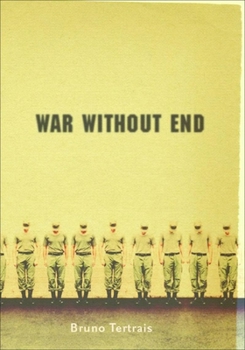
Hardcover War Without End: The View from Abroad Book

ISBN: 1565849639

ISBN13: 9781565849631

War Without End: The View from Abroad

Select Format

Select Condition ThriftBooks Help Icon

Recommended

Format: Hardcover

Condition: Like New

$6.39
Save $15.56!
List Price $21.95
Almost Gone, Only 1 Left!

Book Overview

Is the war in Iraq the beginning of a war without end? As the country seeks to decipher the White House conversations that led to war, Bruno Tertrais, one of Europe's leading defense analysts and former RAND Corporation fellow, takes us on a deeper investigation of American global strategy and its long-term consequences.

War Without End offers a comprehensive examination of the ideas and policies that may have led us into a century of combat. An international authority on nuclear nonproliferation, Bruno Tertrais is uniquely able to look at American political and military thinking since World War II and to trace the ideology that has created the present impasse, including the most thoroughgoing account available of the neoconservative players and ideas that guided the Bush administration into Iraq.

Far from being a "war for oil," War Without End demonstrates that the Iraq invasion is part of a global strategy whose negative consequences are already apparent. Have we unleashed forces, here and abroad, that will trap future generations? These are the questions raised by this brilliant and disturbing book.


Customer Reviews

5 ratings

War Without End

A thought provoking book. A must read for anyone wanting to understand the quetionable political and military strategies that has given rise neoconservatism and the radicalization of Islam.

Much appreciated by graduate US foreign policy class

Of a variety of small texts on the topic of U.S. foreign policy and international relations since 9/11, this was unquestionably the favorite of the students in my graduate seminar on U.S. foreign policy. Tertrais avoids the Bush-bashing of many critics with a carefully reasoned critique that explores both the necessity of addressing the Islamicist challenge and identifies cultural and decision-making issues inherent in US foreign policy that constrains the US. The fact that Tertrais is a European researcher provides him with an unvarnished perspective that is refreshingly different from what my students anticipated. For example, he argues that the US "deserves praise for asking real questions" about the operation of collective security in the 21st century, e.g., "Why should the international system continue working on the basis of rules enacted by the winners of a conflict more than sixty years ago? How can the strategy of deterrence go on being applied when it comes to fanatical leaders or stateless actors? Why maintain regimes of arm control that have the goal of codifying a vanished bipolar balance?" His core theme is that "the real problems rest less in the motives and goals of U.S. strategy than in the consequences of its implementation and in the uncertainty of the nature of its long-term objectives. The strategy followed by the United States generates its own dynamics of escalation, fueled by the radicalization of the Arab and Muslim worlds." Tertrais effectively provides a lucid counterpoint to both Huntington's clash of civilizations and Fukuyama's end of history arguments. My only significant criticism of his analysis is that his Gallic rationality is very uneasy confronting the influence of religious faith on policy. I believe that he seriously overestimates the impact of fundamentalist Christian belief on US foreign policy, and that he grossly exaggerates the role of religious Judaism (as opposed to secular nationalism) in shaping the dynamics of neoconservatism and Israeli policy choices. These, however, are secondary issues to an analysis that is both friendly to the US as an entity and rational in its critique of our response to the challenge posed by Islamicism.

A must read

It is refreshing to read this book written by a Frenchman who clearly has been able to distill the essence of exactly what has been going on in the United States over the past couple of decades. In my foreign travels I have observed that foreigners are much more knowledgable of political developments in the United States than her own citizens. What impressed me most about the author's thesis is that, he not only weaves events of the recent past in terms of various political doctrines in the United States, he also casts this in the light of how US interests and the interests of other countries are affected. Most notably, at the end, he connects this to the future looming confrontation with China. Please encourage your friends and colleagues to read this book.

A great book

I read both the French and the US versions of this book (the latter is an updated and expanded version of the former) and nowhere does the author say that the United States should not have fought WW2 (as claimed by another reviewer). In fact, the author is much more sympathetic to the US than the average French person. This makes his warnings all the more important. In addition, this book is perhaps one of the best analyses that one can find on the "War on Terror". All in all, a great book.

An outsider's view

This nifty little book is a quick read that gives the reader an analysis of the current global war on terrorism. The author gives a broad overview of the underlying etiologies of the war which flow from the events of 11 September and America's response. If you would like one unifying theory of this war we fight, this is the book for you.
Copyright © 2025 Thriftbooks.com Terms of Use | Privacy Policy | Do Not Sell/Share My Personal Information | Cookie Policy | Cookie Preferences | Accessibility Statement
ThriftBooks ® and the ThriftBooks ® logo are registered trademarks of Thrift Books Global, LLC

GoDaddy Verified and Secured