


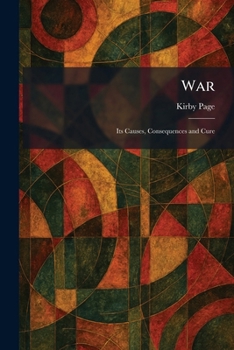
War: Its Causes, Consequences and Cure

Select Format
Select Condition 
Book Overview
"War: Its Causes, Consequences and Cure" is a profound examination of the structural and ideological roots of global conflict. Written in the immediate aftermath of the First World War, Kirby Page provides a detailed analysis of the economic, political, and social forces that drive nations toward militarism. The work delves into the devastating impact of modern warfare on society, ethics, and human progress, arguing that the cycle of violence can only be broken through a fundamental shift in international relations and personal convictions.
Page explores the intricate web of nationalism, imperialism, and secret diplomacy that contributed to the Great War, offering a sobering look at the human and material costs. More than just a critique, the book proposes practical and moral cures for war, emphasizing the importance of international cooperation, disarmament, and the pursuit of social justice. As a significant contribution to the early 20th-century peace movement, this volume remains a poignant reflection on the necessity of non-violence and the challenges of building a stable, peaceful world order. It serves as an essential resource for those interested in the history of pacifism, international ethics, and the evolution of anti-war thought during a pivotal era in global history.
This work has been selected by scholars as being culturally important, and is part of the knowledge base of civilization as we know it. This work was reproduced from the original artifact, and remains as true to the original work as possible. Therefore, you may see the original copyright references, library stamps (as most of these works have been housed in our most important libraries around the world), and other notations in the work.
This work is in the public domain in the United States of America, and possibly other nations. Within the United States, you may freely copy and distribute this work, as no entity (individual or corporate) has a copyright on the body of the work.
As a reproduction of a historical artifact, this work may contain missing or blurred pages, poor pictures, errant marks, etc. Scholars believe, and we concur, that this work is important enough to be preserved, reproduced, and made generally available to the public. We appreciate your support of the preservation process, and thank you for being an important part of keeping this knowledge alive and relevant.
Related Subjects
History Political Science Politics & Social Sciences Religion Religion & SpiritualityCustomer Reviews
ThriftBooks ® and the ThriftBooks ® logo are registered trademarks of Thrift Books Global, LLC
