


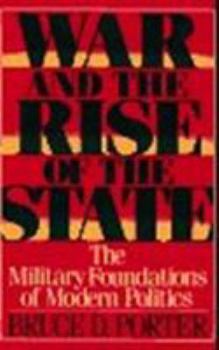
War and the Rise of the State: The Military Foundations of Modern Politics

Select Format
Select Condition 
Book Overview
As Publishers Weekly notes, "Porter, a political scientist at Brigham Young University, demonstrates that wars have been catalysts for increasing the size and power of Western governments since the... This description may be from another edition of this product.
Format:Hardcover
Language:English
ISBN:0029250951
ISBN13:9780029250952
Release Date:January 1994
Publisher:Free Press
Length:380 Pages
Weight:1.50 lbs.
Dimensions:2.0" x 6.5" x 9.6"
Related Subjects
History Military Political Science Politics & Government Politics & Social SciencesCustomer Reviews
4 ratings
Somewhat superfical but intriguing....
Published by Thriftbooks.com User , 17 years ago
As someone with a degree in Political Science with emphasis in Political theory and International Relations, I found this book to be a "mixed bag" of superficiality and intriguing ideas. The superficiality, I think, is due to the author's tackling of a HUGE subject in a book of readable length. The subject matter simply deserves more depth than the 380 pages of this book allows. A book of perhaps three or four times that length would be needed to really get into the "meat" of this subject. And it would be read, and comprehended, by few. What Porter has done has been to skim the surface of the subject: in effect outlining his thesis while giving examples - many examples - to support his conclusions. And those conclusions are intriguing. This book is NOT for the professional political scientist. But it is an excellent "primer" that anyone else can, and should, read to profitably understand many of the forces at work in the world today. Extensively annotated and referenced, one should think of this book as an introductory buffet of delicious samples, rather than a 5 course formal banquet.
Well argued
Published by Thriftbooks.com User , 20 years ago
I started reading this book solely to learn about the eighteenth century, but I found it to be so profound and well written that I had to read it al. Everyone who cares about freedom should read this book. Among the first sentences Porter says that like many people, when he first started to study history he found wars to be an annoying interruption of progress, but that he grew to appreciate that after each war the world was somehow different. The how and why are the subject of the book. Porter shows how war and the need to pay for war has led to increasing state power and larger government. Porter shows that in most European states kings used war to quash representative government, but he also shows the exceptions - Switzerland, Sweden, the Netherlands, Britain, and America. Porter shows how different circumstances in these countries helped lead to representative government of some kind. The 20th century tyrannies of fascism and communism and the rise of the welfare state are also convincing explained.
Amazing
Published by Thriftbooks.com User , 24 years ago
The book, War and the Rise of the State, is very informative and should be a best seller.
Wars make peacetime government bigger
Published by Thriftbooks.com User , 27 years ago
Porter's work is remarkable in both content and readibility. It is an upbeat reply to those who bemoan the general irrelevancy of the Beltway players during these times of peace and prosperity. Furthermore, it clearly documents how much the federal government undergoes growth spurts both during and immediately following the nation's wars. (Clinton himself [as unbelievably egotistical and scary as this may seem] has been quoted lamenting the fact that he is not a wartime President.) This is a book that ought to be read by every public policy wonk who values truth in the slightest... and it's one to be enjoyed by almost anyone who has an interest in America's past and future.
Copyright © 2026 Thriftbooks.com Terms of Use
| Privacy Policy | Do Not
Sell/Share My Personal Information | Cookie Policy | Cookie Preferences | Accessibility Statement
ThriftBooks® and the ThriftBooks® logo are registered trademarks of Thrift Books Global, LLC
ThriftBooks® and the ThriftBooks® logo are registered trademarks of Thrift Books Global, LLC
