


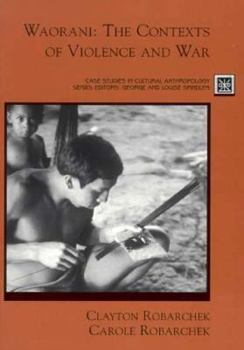
Waorani: The Contexts of Violence and War

Serving as both a narrative account and a general explanatory framework for understanding violence, this case study on the psychological and cultural dynamics of violence focuses on explaining the... This description may be from another edition of this product.
Format:Paperback
Language:English
ISBN:0155037978
ISBN13:9780155037977
Release Date:November 1997
Publisher:Wadsworth Publishing
Length:128 Pages
Weight:0.70 lbs.
Dimensions:9.5" x 0.5" x 6.5"
Customer Reviews
2 ratings
A Wise Book About Human Choices and Society
Published by Thriftbooks.com User , 17 years ago
The Huaorani/Waorani tribe of Ecuador first came to world-wide attention in 1956 when they were known as Aucas (Quichua for "savage"): five American missionaries were speared to death upon trying to establish peaceful contacts with them. Subsequent books by missionaries (e.g., Elisabeth Elliot's "Through Gates of Splendor") and journalists (e.g., Joe Kane's "Savages"), along with the discovery of major oil deposits underneath traditional Waorani homeland brought the knowledge of this tribe to a wider audience. In 2004 a documentary film, "Beyond the Gates of Splendor" was made, looking at the lives of many Waorani and those of the martyred missionaries. In that film, anthropologists Clayton and Carole Robarchek gave articulate, knowledgeable interviews that enhanced the quality of the documentary. This book, "Waorani: The Contexts of Violence and War" is the full-length treatment about their time living with the Waorani and the conclusions they drew about them (which formed the basis for the comments made in the film). The Robarcheks spent time living with the Waorani in 1987 and again on a follow-up trip in 1993. They had previously spent time living with the Semai tribe in Malaysia, quite similar to the Waorani in many respects - hunting with blowguns and darts, cultivating manioc, similar systems of descent, living deep in a rainforest with primitive technology - and yet for all the similarities, the Semai were some of the most peaceful people around whereas the Waorani were one of (if not the) most violent societies on earth. What made the difference? And why did the Waorani murder rate suddenly drop 90% in the early 1960s? These are part of what this book explores. The authors are quite frank in declaring (and demonstrating through the data they collected and carefully analyzed) that they have fundamental disagreements with two popular paradigms for explaining human behavior: sociobiology and ecological determinism. For those who might have read E.O. Wilson's or Jared Diamond's works that touch on these issues, "Waorani: The Contexts of Violence and War" offers a thoughtful alternative viewpoint. (And for those who have read Napoleon Chagnon's theories on tribal violence, this book politely disputes his conclusions.) The main premise of this book is this, that "People's behavior is not the determined result of ecological or biological or socioeconomic forces acting on them but, rather, is motivated by what they want to achieve in their world as they perceive and understand it. Within their experienced reality, people make choices based on the information available to them - information about themselves, about the world around them, and about possible goals and objectives in that world." At 202 pages, this book is long enough to give more than a superficial account of the daily life and history of the Waorani but short enough not to drag on and on. There are maps and black & white photos sprinkled throughout
Violence and Culture
Published by Thriftbooks.com User , 26 years ago
This book is an absolute "must read" for anyone interested in human violence. The Waorani were perhaps the most violent people on earth until peace was brokered by missionaries. They were the terror of their neighbors, but they also killed each other; peace may have saved them from self-destruction. The Robarcheks had previously studied the Semai Senoi of Malaysia, who lived in a similar way--by shifting cultivation in tropical rainforest--but were virtually without any violence, ranking as probably the most peaceful of humans. The Robarcheks sought to see why such similar societies (which even raise their children in broadly similar ways) had such extreme differences in violence level. The most important finding was that both groups were menaced by, and afraid of, stronger neighbors. The Waorani could fight back, but could be secure only if they could truly terrorize their stronger enemies; the Semai could only flee, and learned to deal with danger by flight rather than by fight. The two cultures developed many social and psychological mechanisms for reinforcing these differences. The Robarcheks use these examples to reject naive theories that claim humans are violent or aggressive by nature. In fact, human cultures vary enormously in their approaches toward violence, and humans vary their behavior accordingly. Implications for dealing with violence are discussed in the book, and are of obvious importance for the world.
Copyright © 2026 Thriftbooks.com Terms of Use
| Privacy Policy | Do Not
Sell/Share My Personal Information | Cookie Policy | Cookie Preferences | Accessibility Statement
ThriftBooks® and the ThriftBooks® logo are registered trademarks of Thrift Books Global, LLC
ThriftBooks® and the ThriftBooks® logo are registered trademarks of Thrift Books Global, LLC
