


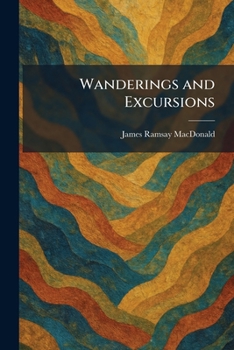
Wanderings and Excursions

Select Format
Select Condition 
Book Overview
"Wanderings and Excursions" is a captivating collection of essays and travelogues penned by James Ramsay MacDonald, reflecting his deep-seated passion for the natural world and the simple act of walking. Though widely recognized for his prominent political career, this work reveals MacDonald as a keen observer of landscape and culture, offering readers a series of intimate sketches from his travels across Scotland, England, and further afield into Europe and the East.
The narratives within this volume blend descriptive prose with personal reflection, as the author finds solace and intellectual stimulation in the rugged highlands, the quiet English countryside, and the bustling streets of foreign cities. MacDonald's writing explores the intersection of nature and human spirit, often touching upon the social and political undercurrents of the early twentieth century. His observations on the beauty of the wild and the character of the people he encounters provide a unique window into the mind of a statesman who found his greatest refreshment in the open air.
This collection serves as both a literary escape and a historical document, capturing the essence of the walking tour tradition while showcasing the lyrical side of one of Britain's most significant political figures. "Wanderings and Excursions" remains an evocative testament to the restorative power of travel and the enduring allure of the great outdoors.
This work has been selected by scholars as being culturally important, and is part of the knowledge base of civilization as we know it. This work was reproduced from the original artifact, and remains as true to the original work as possible. Therefore, you may see the original copyright references, library stamps (as most of these works have been housed in our most important libraries around the world), and other notations in the work.
This work is in the public domain in the United States of America, and possibly other nations. Within the United States, you may freely copy and distribute this work, as no entity (individual or corporate) has a copyright on the body of the work.
As a reproduction of a historical artifact, this work may contain missing or blurred pages, poor pictures, errant marks, etc. Scholars believe, and we concur, that this work is important enough to be preserved, reproduced, and made generally available to the public. We appreciate your support of the preservation process, and thank you for being an important part of keeping this knowledge alive and relevant.
Customer Reviews
ThriftBooks ® and the ThriftBooks ® logo are registered trademarks of Thrift Books Global, LLC
