


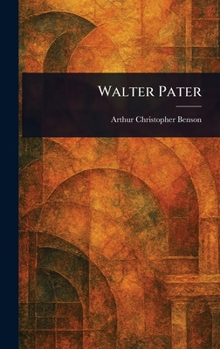
Walter Pater

Delve into the fascinating life and influential work of Walter Pater, a preeminent English author and literary critic of the 19th century. In this insightful biography, Arthur Christopher Benson offers a meticulous portrait of Pater, exploring his intellectual journey and profound impact on Victorian literature and aesthetic thought.
"Walter Pater" chronicles the life of a seminal literary figure whose nuanced prose and unique critical perspective shaped his era's literary landscape. Benson expertly navigates Pater's contributions to literary criticism, positioning him among the most celebrated British critics and literary figures. This compelling account provides a deep understanding of the man behind the seminal essays and philosophical explorations, revealing the influences and inspirations that molded his distinctive voice and enduring legacy. This print edition is an essential read for anyone interested in 19th-century English authors, the evolution of literary criticism, and biographies of cultural luminaries. It offers an invaluable window into the world of a celebrated intellect whose work continues to resonate in the study of literature and aesthetic philosophy.This work has been selected by scholars as being culturally important, and is part of the knowledge base of civilization as we know it.
This work is in the public domain in the United States of America, and possibly other nations. Within the United States, you may freely copy and distribute this work, as no entity (individual or corporate) has a copyright on the body of the work.
Scholars believe, and we concur, that this work is important enough to be preserved, reproduced, and made generally available to the public. We appreciate your support of the preservation process, and thank you for being an important part of keeping this knowledge alive and relevant.
Customer Reviews
ThriftBooks ® and the ThriftBooks ® logo are registered trademarks of Thrift Books Global, LLC
