
Skip to content
Scan a barcode
Scan
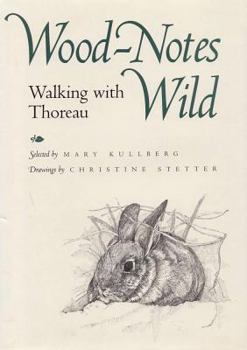
Hardcover Wood-Notes Wild: Wallking with Thoreau Book

ISBN: 0809319888

ISBN13: 9780809319886

Wood-Notes Wild: Wallking with Thoreau

Select Format

Select Condition ThriftBooks Help Icon

Recommended

Format: Hardcover

Condition: Very Good

$11.59
Save $9.41!
List Price $21.00
Almost Gone, Only 2 Left!

Book Overview

Henry David Thoreau earned immortality for his eloquent prose in Walden, the masterpiece that resulted from his communing with nature at Walden Pond in Concord, Massachusetts.

Less widely known are the journals Thoreau kept for twenty-four years as he walked at least four hours a day in the Concord area. From 1837 until 1861, he carried a homemade notebook as he explored the woods, fields, ponds, and rivers of the area. He took notes as he traveled, revising them at home for his journal, which became his major literary project.

First published posthumously in 1906, the fourteen-volume Journal of Henry D. Thoreau shows Thoreau's close relationship with nature, but the Journal runs to a formidable two million words. Taming this daunting literary landmark, Mary Kullberg selects from the Journal, and from Thoreau's other books, essays, and letters, excerpts that create a typical year of Thoreau's nature excursions, clearly illustrating how Thoreau recognized the importance of each natural entity and its relationship to the total habitat, the earth. Thus, the Thoreau who emerges from Wood-Notes Wild is the Thoreau his closest friends knew, Kullberg notes, "brother to the trees, the sun and stars, the rocks, the ponds and rivers, the birds and animals--an exuberant man who felt such a kinship with the earth that he could be no other place but with nature."

In Thoreau's eulogy, Emerson said: "It was a pleasure and a privilege to walk with him. He knew the country like a fox or a bird, and passed through it as freely by paths of his own. He knew every track in the snow or on the ground, and what creature had taken the path before him. His power of observation seemed to indicate additional senses. . . . One must submit abjectly to such a guide, and the reward was great."

Only a privileged few walked with Thoreau, but Wood-Notes Wild gives the reader the opportunity to join Thoreau on his excursions. Kullberg lights the way through these contemplative walks with an epigraph from the master himself: "I come to my solitary woodland walk as the homesick go home. I thus dispose of the superfluous and see things as they are, grand and beautiful."

These words provide a hint as to why Kullberg compiled this fascinating collection. Like Thoreau, she has a close relationship with the natural environment and she has observed nature in many habitats throughout the United States.

Placed throughout the book and enhancing the words of Thoreau are nature drawings by Christine Stetter.

Customer Reviews

5 ratings

Moby-Dick Walks

When I was in a hospital for 6 months, all I did was read this book by Henry David Thoreau. I longed to get outside and walk in the forest and smell the fresh dung of deer, stings of arachnoids and odor of skunks. I couldn't figure out the cryptic meaning the book posits at all. It's my own belief that nature might be a "woman" and Walking might be copulation but he also mentions porcupines in it, so at times I am left clueless. Most of the animals he mentions are now extinct, he was writing in 1825 after Charles Robert Darwin (English naturalist) dropped him off in Maine. I'm not sure if Thoreau was 'lost' and couldn't get back to NYC or if he was just going around in circles. If you're a zoologist, it might be worth your while to try to guess what animals he writes about. Most of the forests he mentions are now developed or industrial swathes of land, forming bland suburban zones and polluting factories. Henry David Thoreau lived on the largest island of Elba where he was killed by the USA government for not paying his taxes on rum. A good read for people of any weight. Moby-Dick or, The Whale (Penguin Classics)

Still Relevant

The words of Thoreau are familiar to all those who have experienced life in the woods. His philosophies and observations are just as relevant today as they were when he first wrote them. In more eloquent words Thoreau explains how In the woods and wild places we find fuel for the soul. Without them we become stagnant in physicality and mentality. I recommend this book to anyone interested in conservation.

Walking

Required reading for freshmen entering SUNY Geneseo in preparation for an Adirondack Adventure. Bought this version after inadvertantly getting an abridged Walking.

In defense of wilderness

More than any book, this argues for experiencing nature and preserving wilderness. Thoreau himself saw that fewer passenger pigeons were visiting and even then was aware of threats. Though first spoken in lectures on 1851, and 1856-1857, and published in June 1862 Atlantic Monthly, a month after his death, it still speak to us in the 21st century. For example ".. what would become of us, if we walked only in a garden or a mall?", . "In wilderness is the preservation of the world." , "To preserve wild animals implies generally the creation of a forest for them to dwell in or resort to. So it is with man". So lace up your shoes, grab your binoculars, and go for a walk and join the tribe of squirrels!

It helped to open my eyes to the world around me!

It is a perfect little book to carry with you for inspiration. It makes me want to take a walk... and the beautiful thing about this book is that it allows me to take a walk in my mind without ever leaving my office or room. I have and will continue to read it over and over.
Copyright © 2026 Thriftbooks.com Terms of Use | Privacy Policy | Do Not Sell/Share My Personal Information | Cookie Policy | Cookie Preferences | Accessibility Statement
ThriftBooks® and the ThriftBooks® logo are registered trademarks of Thrift Books Global, LLC

GoDaddy Verified and Secured