


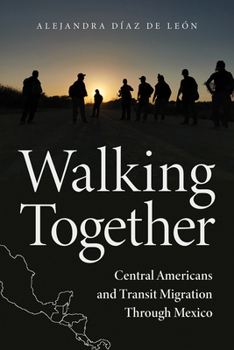
Walking Together: Central Americans and Transit Migration Through Mexico
No Customer Reviews

Select Format
Select Condition 
Book Overview
Migration through Mexico is violent and uncertain, yet in Walking Together we see how this experience bonds some people together like family even though they may not have started that way before the journey. Migrants in transit form several types of social networks, develop trust, and engage in acts of solidarity. The need to be recognized and grieved, compounded by the practical use of pooling information and resources, leads migrants to form small, strong groups called road families. Through the generalized sharing of information and small items such as food and blankets, migrants also form a transient community that includes everyone on the road at the same time. Sociologist Alejandra D?az de Le?n shows the trajectories of families that left together, showing, surprisingly, that families might not be the best social arrangement in transit. Drawing on multisited research, this work contributes to debates on the role of social networks in clandestine migration processes and to discussions on how people create social networks and trust under violent and stressful situations. The detailed ethnographic narratives and accessible writing weave together theory with empirical observations to highlight and humanize the migrant experience. Sitting at the intersection of border studies, immigration studies, and Latinx studies, this concise volume shows how Central American migrants in transit through Mexico survive the precarious and unpredictable road by forming different types of social ties.
Format:Paperback
Language:English
ISBN:0816546452
ISBN13:9780816546459
Release Date:April 2023
Publisher:University of Arizona Press
Length:192 Pages
Weight:0.60 lbs.
Dimensions:0.6" x 6.0" x 8.9"
Customer Reviews
0 rating
Copyright © 2026 Thriftbooks.com
Terms of Use | Privacy Policy | Do Not Sell/Share My Personal Information | Cookie Policy | Cookie Preferences | Accessibility Statement
ThriftBooks ® and the ThriftBooks ® logo are registered trademarks of Thrift Books Global, LLC
ThriftBooks ® and the ThriftBooks ® logo are registered trademarks of Thrift Books Global, LLC
