


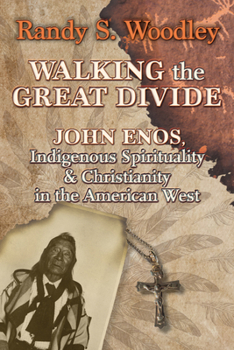
Walking the Great Divide

One of the most remarkable but overlooked chapters in Indigenous-Christian encounter in North America is represented by the three-generation saga of John Enos, his father, and grandfather. John Enos's legacy reveals his signature brand of bridge-building: faith made local, moral courage made generational, and spirituality made true to land.
John Enos (1811-1915) lived a century straddling the most volatile collision of worlds in North American history. Born among the Shoshone and descended from Mohawk Catholics who helped the Plateau tribes midwife an ancient prophecy and faith, Enos refused the false choice between Indigenous spirituality and Christianity, instead embodying a third way: one that reconciled the Spirit-Man Jesus with the sacred traditions and land of his people.
In Walking the Great Divide, Randy Woodley--Indigenous scholar, storyteller, and descendant by marriage--reveals Enos as a model of self-agency. In an era where missionaries and settlers demanded cultural surrender, Enos reimagined how religion can be made true to oneself, one's people, and the earth.
Customer Reviews
ThriftBooks ® and the ThriftBooks ® logo are registered trademarks of Thrift Books Global, LLC
