


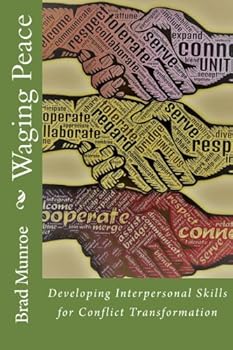
Waging Peace: Developing Interpersonal Skills for Conflict Transformation
No Customer Reviews

Waging Peace: Developing Interpersonal Skills for Conflict Transformation tells the story of a pastor, Francis, who must learn to engage conflict with his congregants constructively. Waging Peace invites readers to think deeply about the necessity and possibilities for civil dialogue and respectful encounters in an era of contention, bitterness, and vitriol. Research data following the 2016 election supported what many have long suspected: people of differing social, ethical and political perspectives talk within their own clans, (so-called "narrowcasting," "silos," or "echo chamber" environments) and talk past one another when engaging in debate with others with whom they do not agree. Waging Peace confronts the inability of many to engage in civil dialogue by providing perspectives and tools that inform and prepare the reader to overcome obstacles to the conduct of such civil interactions within the organizations they lead and in which they participate. The primary purpose of Waging Peace is to provide the reader with tools for constructive conflict engagement rather than destructive conflict avoidance. Secondarily, Waging Peace seeks to frame for the reader individual and societal perspectives that invite participation in the kind of dialogue that deepens reflection upon the difficult challenges of leading religious communities in our polarized culture and learning how to engage conflict in such a manner that members of faith communities may embrace one another in spite of - or even because of - their differences. The primary audience for Waging Peace is leaders of faith communities, especially clergy within the Christian Church. While lay leaders will find Waging Peace accessible and helpful for deepening their understanding of reconciliation studies and developing their leadership within their own community, the role of clergy within a congregation is especially key in the process of facilitating healthy dialogue; therefore, it is expected that pastors and lay leaders will be the primary audience. Secondarily, faith leaders from other religious traditions may benefit from Waging Peace, although some translation from the Christian context to their own tradition will be required. The following positive impacts on the individual reader will be to provide: (1) specific conflict management and mediation tools, including active listening tools, family systems theory interventions, negotiating principles from recognized peacemaking leaders such as the Lombard-Mennonite Peacemaking Center, communication engagement strategies for conflicted situations, a review of conflict modality intervention styles, and an understanding of the role of the brain and emotions in conflict and how to manage emotions constructively;(2) specific frameworks for overcoming the habit of polarization found in much of societal communication, including the concepts from The Arbinger Institute's The Anatomy of Peace and Leadership and Self-Deception, the seminal work of Jewish philosopher Martin Buber, and Christian perspectives from the author's pastoral experience that encourage respectful conversation;(3) an overview of the complexity and difficulties that must be overcome in order to engage in civil dialogue through a review of the moral development theory of Jonathon Haidt, author of The Righteous Mind, as well as through a matrix for ethical decision making developed by the author.
Format:Paperback
Language:English
ISBN:1546706372
ISBN13:9781546706373
Release Date:May 2017
Publisher:CreateSpace Independent Publishing Platform
Length:200 Pages
Weight:0.80 lbs.
Dimensions:9.0" x 0.5" x 6.0"
Related Subjects
Parenting & RelationshipsCustomer Reviews
0 rating
Copyright © 2026 Thriftbooks.com Terms of Use
| Privacy Policy | Do Not
Sell/Share My Personal Information | Cookie Policy | Cookie Preferences | Accessibility Statement
ThriftBooks® and the ThriftBooks® logo are registered trademarks of Thrift Books Global, LLC
ThriftBooks® and the ThriftBooks® logo are registered trademarks of Thrift Books Global, LLC
