


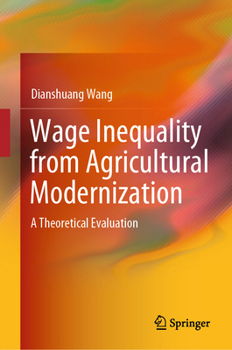
Wage Inequality from Agricultural Modernization: A Theoretical Evaluation
No Customer Reviews

This book integrates the agricultural producer service sector into a three-sector general equilibrium framework to examine the modernization of small-scale agriculture in developing economies. By incorporating agricultural transformation and rural-urban migration dynamics, it presents a theoretical analysis of the determinants of wage inequality between skilled and unskilled labor from multiple perspectives. Over the past few decades, industrialization and urbanization have progressed in parallel, driving the modernization of the agricultural sector. Traditional development economics often conceptualizes agricultural modernization within the context of large-scale operations, assuming that traditional agriculture can directly adopt modern non-agricultural intermediate inputs after some transformations. However, small-scale agriculture--the dominant form in developing countries--follows a distinct modernization path. This divergence manifests in two key ways. First, labor substitution and migration. The introduction of modern intermediate non-agricultural inputs tends to displace agricultural labor, accelerating rural-urban migration. Second, the role of the agricultural producer service sector: Due to the prevalence of small-scale operations, an intermediary sector--the agricultural producer service sector--emerges to facilitate the modernization process. These differences significantly influence intersectoral labor allocation and wage inequality. Given that agricultural modernization, policy shifts, and socioeconomic changes concurrently affect labor allocation, it is crucial to analyze how these exogenous factors shape wage disparities in the presence of agricultural transformation. To model this process, the book establishes a two-layer vertical production structure: non-agricultural goods are partially utilized by the agricultural producer service sector, which then produces intermediate inputs that substitute for agricultural labor. The study focuses on three major factors that profoundly impact rural labor migration and wage inequality: pro-rural policies(mitigation labor market distortion, raising rural public infrastructure, increased agricultural subsidies), FDI and internal remittances, and technological progress (green technological progress and skill-biased technical change). The findings offer novel insights into wage inequality in developing economies and provide a theoretical foundation for formulating development policies.
Format:Hardcover
Language:English
ISBN:9819668506
ISBN13:9789819668502
Release Date:June 2025
Publisher:Springer
Length:252 Pages
Weight:1.17 lbs.
Dimensions:0.8" x 6.5" x 9.4"
Customer Reviews
0 rating
Copyright © 2026 Thriftbooks.com
Terms of Use | Privacy Policy | Do Not Sell/Share My Personal Information | Cookie Policy | Cookie Preferences | Accessibility Statement
ThriftBooks ® and the ThriftBooks ® logo are registered trademarks of Thrift Books Global, LLC
ThriftBooks ® and the ThriftBooks ® logo are registered trademarks of Thrift Books Global, LLC
