


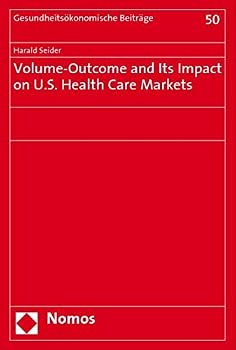
Volume-outcome and Its Impact on U.s. Health Care Markets (Gesundheitsokonomische Beitrage)
No Customer Reviews

The direction of causality matters for policy procedure. If volume causes outcome, then policies supporting centralization of procedures in a few facilities may make sense. Specialty hospitals may have the benefit of producing better outcomes. Antitrust analysis of hospital mergers should probably consider any improved outcomes when evaluating the impact of the merger. Accordingly, the author analyzes the causality of the volume-outcome relationship for coronary artery bypass grafts (CABGs) and finds that volume might play the crucial role for hospitals quality. This finding makes minimum volume requirements a reasonable policy which is shown by a simulation on Californian data. However, the primary focus of the finding lies in US Antitrust application. Due to a causative volume-outcome relationship, a hospital merger may have welfare enhancing effects despite possible price increases. Patients will be better off as long as the quality improvement outweighs the loss of welfare due to the price increase. This is shown by a standard merger case simulation as well as a real merger, which took place in California in 1999. Results suggest that the presence of a volume-outcome relationship might serve as an efficiency defense at Antitrust trials.
Format:Paperback
Language:English
ISBN:3832921699
ISBN13:9783832921699
Release Date:September 2006
Publisher:Nomos Verlagsgesellschaft Mbh & Co
Length:246 Pages
Weight:0.79 lbs.
Dimensions:9.0" x 0.8" x 6.1"
Customer Reviews
0 rating
Copyright © 2026 Thriftbooks.com
Terms of Use | Privacy Policy | Do Not Sell/Share My Personal Information | Cookie Policy | Cookie Preferences | Accessibility Statement
ThriftBooks ® and the ThriftBooks ® logo are registered trademarks of Thrift Books Global, LLC
ThriftBooks ® and the ThriftBooks ® logo are registered trademarks of Thrift Books Global, LLC
