


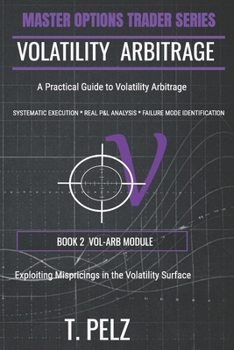
Volatility Arbitrage (Master Option Trader Series): Exploiting Mispricings on the Volatility Surface
No Customer Reviews

Most traders who call themselves volatility arbitrageurs are running directional volatility positions dressed in the language of arbitrage. This book corrects that. Completely. Volatility arbitrage is not about predicting whether volatility will go up or down. It is about recognizing when one part of the volatility surface is mispriced relative to another and systematically extracting that spread before it closes. That shift from absolute to relative is the dividing line between retail options trading and institutional volatility work.
Volatility Arbitrage, Book 2 of the Master Option Trader Series, teaches you to execute that framework at an institutional level. Calendar spreads, Diagonal structures, Ratio trades, Dispersion and correlation arbitrage, multi-expiration vega risk, and the full mechanics of the VIX term structure including a forensic case study of the August 5, 2024 backwardation event, the most extreme term slope reading outside 2008 and COVID. Inside: The Volatility Surface: geometry, curvature, slope, and distortion signalsCalendars, Diagonals, and Ratio spreads built for relative-value executionDispersion and Implied Correlation Arbitrage, the institutional frameworkVIX Term Structure convergence trades: entry, sizing, and exit disciplineEight hidden killers of multi-expiry positions, and how to recognize them before they cost youThe Vol Arb Operating System: pre-trade workflow, shock matrix, and survival-probability sizingMonte Carlo Surface Simulation for path risk evaluation
Theta is not the edge. The edge is the mispricing. This book teaches you to find it, size it, and extract it and to sit out when conditions make the trade dangerous. For traders who finished Book 1 and are ready to move from convexity to the surface.
Volatility Arbitrage, Book 2 of the Master Option Trader Series, teaches you to execute that framework at an institutional level. Calendar spreads, Diagonal structures, Ratio trades, Dispersion and correlation arbitrage, multi-expiration vega risk, and the full mechanics of the VIX term structure including a forensic case study of the August 5, 2024 backwardation event, the most extreme term slope reading outside 2008 and COVID. Inside: The Volatility Surface: geometry, curvature, slope, and distortion signalsCalendars, Diagonals, and Ratio spreads built for relative-value executionDispersion and Implied Correlation Arbitrage, the institutional frameworkVIX Term Structure convergence trades: entry, sizing, and exit disciplineEight hidden killers of multi-expiry positions, and how to recognize them before they cost youThe Vol Arb Operating System: pre-trade workflow, shock matrix, and survival-probability sizingMonte Carlo Surface Simulation for path risk evaluation
Theta is not the edge. The edge is the mispricing. This book teaches you to find it, size it, and extract it and to sit out when conditions make the trade dangerous. For traders who finished Book 1 and are ready to move from convexity to the surface.
Format:Paperback
Language:English
ISBN:B0GS2L6M2S
ISBN13:9798251459548
Release Date:March 2026
Publisher:Independently Published
Length:198 Pages
Weight:0.60 lbs.
Dimensions:0.4" x 6.0" x 9.0"
Customer Reviews
0 rating
Copyright © 2026 Thriftbooks.com
Terms of Use | Privacy Policy | Do Not Sell/Share My Personal Information | Cookie Policy | Cookie Preferences | Accessibility Statement
ThriftBooks ® and the ThriftBooks ® logo are registered trademarks of Thrift Books Global, LLC
ThriftBooks ® and the ThriftBooks ® logo are registered trademarks of Thrift Books Global, LLC
