


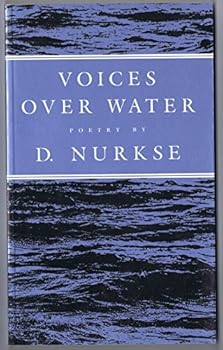
Voices over Water


This collection of poems are the record of the lives of a married couple who emigrate from Estonia to Canada during the first half of this century. The woman, a preacher's daughter and musician from... This description may be from another edition of this product.
Format:Paperback
Language:English
ISBN:1555971881
ISBN13:9781555971885
Release Date:January 1993
Publisher:Graywolf Pr
Length:90 Pages
Weight:0.40 lbs.
Dimensions:9.0" x 0.3" x 5.5"
Related Subjects
PoetryCustomer Reviews
2 ratings
Lovers in Slow Time
Published by Thriftbooks.com User , 23 years ago
Nurkse is a master of the luminous detail and singing line. This book shifts from the memories of a young peasant wife describing events of war, love and peace in the old country (Estonia), to an interplay with those of her husband, describing early life in the very foreign promised land (Canada), and finally returning to her voice and her life, now alone, a grandmother and pensioner lost in the Babel and silence of the big city. He is able to pull us into these materials not only with the voice of his speakers but with the emotional quality of the things they touch: We children came from anger. On a calm night my parents could elude each other, as if in a capital city, in the hut with the bleached pine floor ..Mother crushed myrtles between her fingers The voice arrests with its opening statement, but that authority of rhythm is backed up and given a visceral authenticity by the floor, the myrtles, the immediacy of sensory impressions. This is more than sitting in on Nurkse's grandmother telling stories- this is listening in to a girlfriend from the old country sharing the family intimacies over shared washing, this is a re-creation of a past habit of life.Not least of the book's pleasures is the insight it shares into the nature of marriage, as viewed by two fairly hard-headed people who live difficult lives in hard circumstances and survive not only in body but in the created body between them. Here the husband and wife speak: This preacher's daughter claims to love me in darkness and in church, and she can prove it... She doesn't know I was already in love before she shared my bed, with those fruit trees.. they were mine clear, countersigned, paid for by sweat not by love, lies, happiness or suffering. The wedding sheet frayed under us so I cut it in four and sewed it back with the unworn edges at the center.. ....and still each night we'd sit at the edge of the matress trembling with exhaustion and at last turn as if unwed, to that silence between us. Nurkse's form is rigid enough to inspire a confidence in the ear but never flashy or attention grabbing in its rhymes. One never loses the sensual impression of a speaker confiding, sometimes whispering to you. The allusions to and descriptions of music which weave through the poems are at times most powerful in the keen awareness of silence: silence of exile, silence of love and silence of death. This is a fine book and I found myself trying to emulate the tricks of its voice when writing in the hour immediately after reading it: that's how affecting the voice proved. The opening section is on the whole the most lively and colourful, a certain sameness bred perhaps of fatigue creeps into some of the poems in the middle section, and I found myself wondering if Nurkse had run out of juice, writing the same poem over and over in endless movements. However, throughout each part of the book there are luminous passages, piercing details and an affecting portrait of a li
A book of narrative poetry
Published by Thriftbooks.com User , 27 years ago
The New Yorker, Jan. 30, 1995: "These poems, which tell the story of an Estonian couple who emigrate to Canada in the early part of this century, work both as discrete, individually imagined lyrics and also as chapters in an ongoing narrative of genuinely engaging lives. There are no sagging makeshifts here. A high proportion of the poems are gems of gravid simplicity, and Nurkse's rhetorical periods can be breathtaking..." Recommended Reading
Copyright © 2026 Thriftbooks.com Terms of Use
| Privacy Policy | Do Not
Sell/Share My Personal Information | Cookie Policy | Cookie Preferences | Accessibility Statement
ThriftBooks® and the ThriftBooks® logo are registered trademarks of Thrift Books Global, LLC
ThriftBooks® and the ThriftBooks® logo are registered trademarks of Thrift Books Global, LLC
