


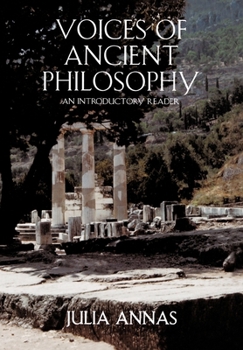
Voices of Ancient Philosophy: An Introductory Reader

Select Format
Select Condition 
Book Overview
Edited by one of the most renowned scholars in the field, Voices of Ancient Philosophy: An Introductory Reader is a unique and accessible introduction to the richness of ancient philosophy. Featuring a topical--as opposed to chronological--organization, this text introduces students to the wide range of approaches and traditions in ancient philosophy. In each section Annas presents the ancient debates on a particular philosophical topic, drawing on a greater diversity of ancient sources than a chronological approach allows. The book is divided into six sections: Fate and Freedom; Reason and Emotion; Knowledge, Belief, and Skepticism; Metaphysical Questions; How Should You Live?; and Society and the State. Annas includes a generous selection of the works of Plato and Aristotle, as well as those of the Stoics, Epicureans, and Skeptics. She also includes selections from less familiar philosophers and from authors in whose works philosophical issues arise, such as poets, medical writers, historians, and Jewish and Christian writers. The volume features biographical sketches of the philosophers, a timeline, and short discussions of the major movements in ancient philosophy. An excellent text for courses in ancient philosophy and history of philosophy, Voices of Ancient Philosophy: An Introductory Reader will also be of interest to scholars and general readers.
Format:Paperback
Language:English
ISBN:0195126955
ISBN13:9780195126952
Release Date:September 2000
Publisher:Oxford University Press, Incorporated
Length:480 Pages
Weight:1.52 lbs.
Dimensions:0.9" x 6.4" x 9.2"
Customer Reviews
1 rating
Unique presentation of ancient philosophy as conversation
Published by Thriftbooks.com User , 20 years ago
Julia Annas has produced a remarkable volume intended as a reader for introductory ancient philosophy classes. I'm using it in my class right now, and I'm finding it to be exactly what I was looking for. An upper level ancient philosophy course should be more directed toward examining the whole of a philosopher's thought, and reading longer works in context with the entire philosopher's outlook is ideal in that environment. In an introductory course, however, students are taking philosophy for the first time, and the ancient philosophers are merely a means to learning philosophy for the first time. Focusing on issues is thus more important than getting the whole of a philosopher's thought down in every way. This book presents six topics, with ancient philosophers' writings on the topics organized as a conversation. In any given topic, you usually find Plato, Aristotle, the Stoics, and Epicurus, with some representation by the pre-Socratics, the Sophists, the Skeptics, the Neo-Platonists, and even Augustine and Boethius to round out topics not discussed as much by the ancients. You also will find those whose work is not widely recognized as philosophy but has a bearing on philosophy, including Homer, the Hippocratic school, an excerpt from one of the Maccabean books, and a short snippet of Jesus' Sermon on the Mount. The most prominent ancient Greek and Roman philosophers dominate, however, since this book is about them. The six topics are (1) Fate and Freedom (which includes divine foreknowledge and the fixity of the future), (2) Reason and Emotion, (3) Knowledge, Belief, and Skepticism (including relativism), (4) Metaphysical Questions (including paradoxes, the Forms, cause/explanation, and time), (5) How Should You Live?, and (6) Society and the State. Annas comments after the readings, sometimes on a few readings at once and sometimes on each reading. Her comments are suggestive of possible interpretations of difficult texts and potential criticisms of arguments, and often they simply pull together themes throughout the works of a philosopher or throughout the unit among different philosophers. Most of the time they're helpful to introductory students without simply summarizing the readings and allowing them not to read the text itself. Much in the comments is for further thought, though some is just to bring out things that may not be clear. As with any project like this, one might make different choices about which topics and readings to include and what to say in the comments, but Annas is one of the most prominent scholars of ancient philosophy today, and reading what she considers to be the most important material for an introductory course in ancient philosophy is certainly going to give someone a good understanding of what there is, even if another expert might have preferred other things included instead or in addition. Overall, I highly recommend this book for those first approaching ancient philosophy, and I consider it an exce
Copyright © 2026 Thriftbooks.com
Terms of Use | Privacy Policy | Do Not Sell/Share My Personal Information | Cookie Policy | Cookie Preferences | Accessibility Statement
ThriftBooks ® and the ThriftBooks ® logo are registered trademarks of Thrift Books Global, LLC
ThriftBooks ® and the ThriftBooks ® logo are registered trademarks of Thrift Books Global, LLC
