


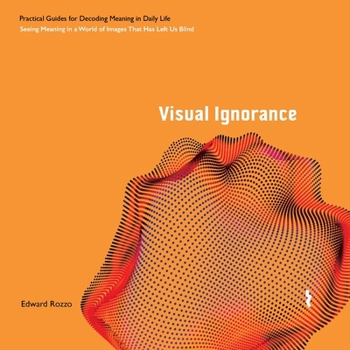
Visual Ignorance: Seeing Meaning in a World of Images That Has Left Us Blind (Practical Guides for Decoding Meaning in Daily Life)

We are the most visually saturated society in history, and arguably the least visually literate. Visual Ignorance argues that our capacity for genuine visual understanding (the kind our ancestors brought to a cave wall or a woven pattern) has been steadily hollowed out, even as the sheer volume of images around us has exploded.
The book traces this transition as a historical arc: from prehistoric symbolic marks on stone, weaving and pottery, through the rise of portraiture and photography, into the image-saturated worlds of advertising, consumer culture, and social media. Along the way, it asks a deceptively simple question: what does it actually mean to see something, rather than merely look at it? This book shows how each new image technology has changed the answer, usually at a cost we rarely notice.
Then the book educates the reader on how to use semiotics and iconology in order to understand any image, anywhere.
Written in a companionable, easy to read voice Visual Ignorance is both a diagnosis and a toolkit. Its second half hands readers concrete ways to read the images that surround them: advertisements, family photographs, museum paintings, and the pictures they scroll past a hundred times a day.
Part of the Practical Guides for Decoding Meaning in Daily Life series from Meaning Works. Richly illustrated, full color throughout.
Customer Reviews
ThriftBooks ® and the ThriftBooks ® logo are registered trademarks of Thrift Books Global, LLC
