


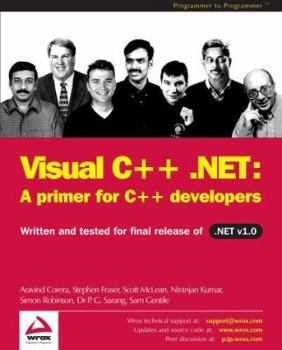
Visual C++ .NET: A Primer for C++ Developers


Visual C++ .NET is the latest incarnation of Microsoft's popular Visual C++ programming language. It has something of a unique character among all the .NET languages. Unlike the other Visual Studio... This description may be from another edition of this product.
Format:Paperback
Language:English
ISBN:1861005962
ISBN13:9781861005960
Release Date:March 2002
Publisher:Apress
Length:462 Pages
Weight:1.75 lbs.
Dimensions:8.8" x 1.3" x 7.3"
Customer Reviews
3 ratings
Good info for VC++ developers
Published by Thriftbooks.com User , 20 years ago
This book will inform you about the changes (ahem improvements) to the C++ language under .NET. Although some of the examples have bugs, it does not deter the authors from teaching you C++ under .NET. It is a very good introductory book for experienced C++ developers interested in moving to .NET.
Nice ATL section.
Published by Thriftbooks.com User , 21 years ago
with one or two other .net C++ books would be perfect.Very good explenation of unicode strings and how they relate to BSTR strings.
Not perfect, but has a lot of information
Published by Thriftbooks.com User , 23 years ago
Managed C++ is a very difficult area and there is not a lot of books in this area. Most of the books seem to concentrate on C# or VB.NET. This is sad because it seems like a lot of the current work to be done in .NET has a lot to do with taking the existing millions of lines of unmanaged code and COM code and making it work/or port to .NET. This can only be done with Managed C++. The book does not pupport to be a complete reference in this area. It states in the Introduction that "At heart, this book is pragmatic: its purpose is to tell experienced C++ programmers what they need to know about Visual C++.NET" and for the most part, I do believe that this has been accomplished.The first chapter is quick overview on what's new in Visual C++.NET. This didn't do much for me but is a quick glance. Chapter 2 "Introduction to Managed C++" is quite good, IMHO. It takes all of the .NET concepts and shows the Managed C++ keywords to perform it. Chapter 3 on Assemblies is pretty good but does not drill down far enough. A tie to PE files is not made. I did learn quite a bit about Resources though which I did not understand before. Attributes and Reflection, Chapter 4 is excellent. These features are very important in .NET. Chapter 5 on .NET Framework utility classes, I felt was a good overview on something that could easily fill 1200 pages. I especially liked Chapters 7 and 8 "Managed and Unmanaged Code" and "COM Interoperability." I feel these are the heart of Managed C++. In Chapter 7, the authors do a fine job of presenting the differences between managed and unmanaged code and the IJW mechanism. I do feel that the example class chosen to be warpped, an integer linked list could have been better and doesn't cover all the cases. The P/Invoke discussion is quite good. The COM Interop chapter is excellent - it has good examples. All in all, I think that the authors did a fairly good job in writing about a fairly complex area.
Copyright © 2025 Thriftbooks.com
Terms of Use | Privacy Policy | Do Not Sell/Share My Personal Information | Cookie Policy | Cookie Preferences | Accessibility Statement
ThriftBooks ® and the ThriftBooks ® logo are registered trademarks of Thrift Books Global, LLC
ThriftBooks ® and the ThriftBooks ® logo are registered trademarks of Thrift Books Global, LLC
