


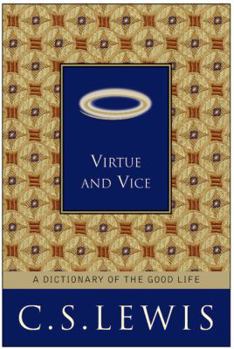
Virtue and Vice: A Dictionary of the Good Life

Select Format
Select Condition 
Book Overview
A Pocket Guide to Goodness Few writers have inspired more readers than author C. S. Lewis -- both through the enchanting volumes of his children's series and through his captivating adult classics such as Mere Christianity, The Screwtape Letters, The Great Divorce, and numerous others. Drawn from many works, this volume collects dictionary-like entries of Lewis's keenest observations and best advice on how to live a truly good life. From ambition to charity, despair to duty, hope to humility, Lewis delivers clear, illuminating definitions to live by.
Format:Hardcover
Language:English
ISBN:0060761512
ISBN13:9780060761516
Release Date:February 2005
Publisher:HarperOne
Length:112 Pages
Weight:0.57 lbs.
Dimensions:6.0" x 0.6" x 4.0"
Age Range:16 years and up
Customer Reviews
2 ratings
WONDERFUL LITTLE BOOK TO READ AND TO THINK ABOUT.
Published by Thriftbooks.com User , 18 years ago
This work is a small collection, less than 100 pages, of writings by C.S. Lewis. They are taken from other works by the author, and the editor of this particular book, Patricia S. Klein, has formated these writings in the form of a dictionary. The subject, of course, is virture and vice and how it is preceived. I do recommend that the book be read front to cover, just as a normal book would be read, as many of the terms addressed by Lewis, such as ambition, charity, chastity, freedom, and many, many other terms are rather skillfully linked here. This of course is the author's take on the subject matter and many of course will, and most certainly should, take other views. The nice thing about this work though is, that for the most part, the author makes quite good sense. I would suspect that no matter what your religious views are, or nonreligions views, as the case may be, that some very nice bits of wisdom will shine though for you in this one. From a personal view point, I simply enjoy C.S. Lewis' writing style and could quite well read and enjoy it just for the simple delight in following the author's syntax and thought process. Another reviewer here has given us a wonderful oversight, complete with background, to this work, so I will not babble on further. I do recommend this one quite highly.
Speaking definitively...
Published by Thriftbooks.com User , 20 years ago
C.S. Lewis was a rare individual. One of the few non-clerics to be recognised as a theologian by the Anglican church, he put forth the case for Christianity in general in ways that many Christians beyond the Anglican world can accept, and a clear description for non-Christians of what Christian faith and practice should be. Indeed, Lewis says in his introduction that this text (or indeed, hardly any other he produced) will help in deciding between Christian denominations. While he describes himself as a 'very ordinary layman' in the Church of England, he looks to the broader picture of Christianity, particularly for those who have little or no background. The discussion of division points rarely wins a convert, Lewis observed, and so he leaves the issues of ecclesiology and high theology differences to 'experts'. Lewis is of course selling himself short in this regard, but it helps to reinforce his point. This book derives from several of his works: 'Mere Christianity'; 'Miracles'; 'The Problem of Pain'; 'The Great Divorce'; 'A Grief Observed', and even 'The Screwtape Letters'. This book is set up as a kind of glossary of terms that are common to the Christian experience and common to Lewis' writing - it is a very useful text to have handy while reading other of Lewis' work. The terms here can be theological or secular, philosophical or mundane. For example, there is an entry on 'Money' - this leads to a discussion on poverty, economy, and true wealth. There is an entry on 'Despair' that begins in the words of the demon Screwtape. One finds entries on both 'Peer Pressure' and 'Perfection, Attainment of...', 'Sinfulness' and 'Forgiveness'. This is a good, thought-provoking book. While not really done in a narrative style, it can be read straight through (indeed, should be read through) as each self-contained definition and exposition leads to a further understanding of the other terms - like true dictionaries, it is self-reflexive and self-referential, with each term working to help clarify and refine the other terms. Lewis probably surprised the listeners of his radio broadcasts by starting a statement, 'When I was an atheist...' Lewis is a late-comer to Christianity (most Anglicans in England were cradle-Anglicans). Thus Lewis can speak with the authority of one having deliberately chosen and found Christianity, rather than one who by accident of birth never knew any other (although the case can be made that Lewis was certainly raised in a culture dominated by Christendom). However, Lewis is not writing exclusively for Anglicans - his writing is meant for the wider Christian audience; in one book, he states that those looking for help deciding between one denomination and another will find little help in much of his writing. This particular book carries an editor's name: Patricia S. Klein (some of the volumes of this series have no editor specified). In this volume, Klein produced an introduction that sets the stage for the read
Copyright © 2026 Thriftbooks.com Terms of Use
| Privacy Policy | Do Not
Sell/Share My Personal Information | Cookie Policy | Cookie Preferences | Accessibility Statement
ThriftBooks® and the ThriftBooks® logo are registered trademarks of Thrift Books Global, LLC
ThriftBooks® and the ThriftBooks® logo are registered trademarks of Thrift Books Global, LLC
