


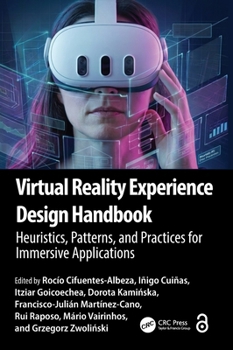
Virtual Reality Experience Design Handbook: Heuristics, Patterns, and Practices for Immersive Applications
No Customer Reviews

Aimed at designers, developers, and product teams, this book bridges the gap between traditional 2D design and the challenges of embodied interaction. Moving beyond theory, it provides actionable tools - including a VR-specific heuristic framework, checklists, and templates - to simplify complex design decisions.
Format:Hardcover
Language:English
ISBN:1041333749
ISBN13:9781041333746
Release Date:September 2026
Publisher:CRC Press
Length:244 Pages
Weight:1.47 lbs.
Dimensions:0.6" x 7.0" x 10.0"
Customer Reviews
0 rating
Copyright © 2026 Thriftbooks.com
Terms of Use | Privacy Policy | Do Not Sell/Share My Personal Information | Cookie Policy | Cookie Preferences | Accessibility Statement
ThriftBooks ® and the ThriftBooks ® logo are registered trademarks of Thrift Books Global, LLC
ThriftBooks ® and the ThriftBooks ® logo are registered trademarks of Thrift Books Global, LLC
