


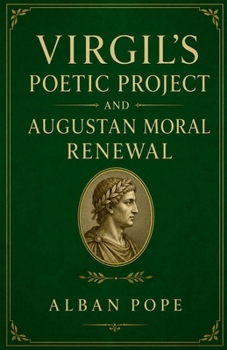
Virgil's Poetic Project and Augustan Moral Renewal
No Customer Reviews

This book explores how Virgil uses his three major works to construct a systematic, evolving discourse on the nature of virtue, authority, and moral responsibility in the new Augustan world. The trajectory of his poetic career is itself a deliberate moral and artistic ascent, mirroring the traditional rota Virgilii (the wheel of Virgil) that moves from the humble, low-style pastoral world to the middle style of agricultural epic, and finally to the high style of national foundation myth. In each of these generic spaces, Virgil redefines what it means to be a moral agent in a changing political landscape.
Format:Paperback
Language:English
ISBN:B0H3MJ6NBN
ISBN13:9798235364677
Release Date:May 2026
Publisher:Colloquium Verlag
Length:166 Pages
Weight:0.44 lbs.
Dimensions:0.3" x 5.5" x 8.5"
Customer Reviews
0 rating
Copyright © 2026 Thriftbooks.com
Terms of Use | Privacy Policy | Do Not Sell/Share My Personal Information | Cookie Policy | Cookie Preferences | Accessibility Statement
ThriftBooks ® and the ThriftBooks ® logo are registered trademarks of Thrift Books Global, LLC
ThriftBooks ® and the ThriftBooks ® logo are registered trademarks of Thrift Books Global, LLC
