


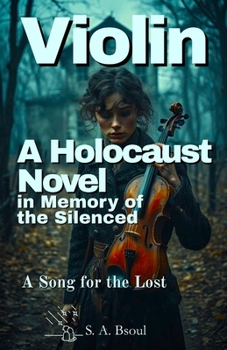
Violin: A Holocaust Novel in Memory of the Silenced

Set during the Holocaust, Violin is a haunting and lyrical exploration of love, loss, and survival. This is Chava's story, a young Jewish girl whose innocence is shattered by the rise of the Nazi regime.
At first, it is only a trembling, a high, fragile note quivering in the dark like a moth against a windowpane. Then it deepens. The bow draws across the strings like a blade across the soul, and suddenly, the melody is no longer outside the listener. It is inside.
It begins with the soft innocence of childhood, where music is the heartbeat of her home, and follows her through the fragile beauty of youth, the terror of war, and the quiet resilience of the human spirit.
As the Nazi regime tightens its grip, Chava's world begins to fracture. The sounds of war infiltrate her home, the shrieking of sirens, the pounding of boots on cobblestones, the whispered conversations that vanish the moment she enters the room. The violin, once a symbol of peace, now weeps in a world turned upside down, playing the soundtrack of a broken world.
The violin is her first voice, a connection to her parents, and a silent companion to her joy. But as the shadows deepen and war approaches like a storm, the music begins to shift.
Chava, once full of life and love, finds herself at the center of a tragedy too vast to comprehend.
From her early childhood, filled with music, where the violin is her closest companion, to the unimaginable devastation of war, Chava's life is shaped by the melody that both comforts and torments her. The violin, once a sweet sound of innocence, begins to echo the sorrow and chaos of a world torn apart.
As Chava faces the horrors of war, losing family, home, and everything she once held dear, her violin becomes both her refuge and her torment. The high notes are the sound of a child's unspoken grief, but with each stroke of the bow, Chava grows stronger. The violin cries out, its voice pulling at the threads of her heart, until every note feels like a blade, sharp and inevitable.
But as the war tears apart her world, Chava is left to face what remains, a heartbroken young girl, her spirit both broken and unbroken. The violin becomes her only means of survival. Each string pulled tight is a call for release, a plea for healing. But when the music wails, it isn't just sound. It is felt, like a hand reaching into the chest, squeezing the heart until the tears come hot and fast, until the body is nothing but an open wound, raw and singing with grief.
Through Chava's journey, you will discover the price of survival, the price of remembering, and the haunting beauty of a love that echoes through time. The violin is not just a memory; it is the bridge between Chava and her lost family. It is the last whisper of their voices, carried across the strings with every breath she takes.
As the final note fades, it doesn't vanish. It lingers, like a breath held too long, caught between the past and the future. It becomes the pulse of her survival, the sound of a spirit that refuses to break, even in the face of unimaginable loss. Chava carries this final note with her, the memory of it etched in her soul, never forgotten, never again. It is her last and greatest song, a song of resilience, of remembering, and of finding the will to keep moving forward.
Customer Reviews
ThriftBooks® and the ThriftBooks® logo are registered trademarks of Thrift Books Global, LLC
