


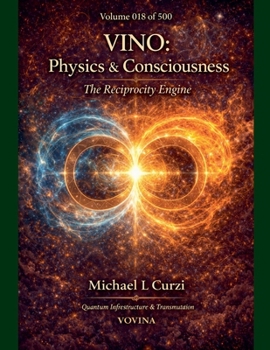
Vino: Physics & Consciousness: The Reciprocity Engine

VINO: Physics & Consciousness - The Reciprocity Engine is Book 018 in Michael L. Curzi's 500-volume philosophical canon, the Vovina Ontological OmniTautology. Part of the VINO: Physics & Consciousness sequence within the Physics & Energy branch of the project, the volume investigates the relationship between physical law and conscious observation through the principle of reciprocity.
The book centers on the Sanskrit root Vāyu, interpreted here as the exchange of force or interaction between systems. This concept becomes the foundation for examining how physical processes and conscious awareness interact within a unified framework. Curzi proposes that reciprocity-mutual influence between observer and observed-is not merely a philosophical idea but a structural feature of reality.
Structured across nineteen chapters using the architectural pattern employed throughout the VOVINA canon, the work progresses through stages of observation, discrimination, application, connection, and integration. This layered approach mirrors both scientific investigation and contemplative inquiry, guiding readers from conceptual analysis toward experiential understanding.
A central thesis of the book is that two of the most enduring questions in modern thought-the measurement problem in quantum physics and the hard problem of consciousness-are not separate puzzles but different perspectives on the same underlying phenomenon. Physics asks how observation affects reality, while philosophy asks how reality produces observation. The VINO framework proposes that both questions converge at a conceptual fulcrum called the Neutral Point, where observation and physical process become inseparable aspects of a unified system.
The text introduces the idea of a consciousness-coupling constant, suggesting that observation correlates the observer's state with one branch of a system's possibilities rather than causing a simple collapse of the wave function. Through this framework, the act of observation becomes a participatory process linking consciousness and physical phenomena.
Drawing from quantum mechanics, systems theory, and contemplative philosophy, the book explores how principles such as holographic information structure, negentropy, and resonance appear across both physical and cognitive domains. Concepts from Advaita Vedanta and other contemplative traditions are examined alongside modern theoretical physics to illustrate how different intellectual traditions converge on similar insights about unity and interdependence.
Within the broader VOVINA canon, The Reciprocity Engine contributes to the ongoing investigation known as Variable X, the unresolved principle connecting all five hundred volumes of the series.
By integrating physics, philosophy, and contemplative insight, the book proposes that reciprocity-the mutual participation of observer and universe-may be the fundamental engine driving both consciousness and the evolution of knowledge.
Bowker Summary (
VINO: Physics & Consciousness - The Reciprocity Engine is Book 018 in Michael L. Curzi's Vovina Ontological OmniTautology, a 500-volume interdisciplinary project exploring relationships between science, philosophy, and consciousness. The volume belongs to the VINO: Physics & Consciousness series within the Physics & Energy branch of the canon.
VINO: Physics & Consciousness - The Reciprocity Engine offers an interdisciplinary exploration of how the reciprocal relationship between observer and universe may shape both scientific understanding and human experience.
Customer Reviews
ThriftBooks® and the ThriftBooks® logo are registered trademarks of Thrift Books Global, LLC
