


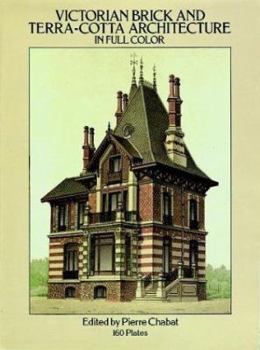
Victorian Brick and Terra-Cotta Architecture in Full Color: 160 Plates (Dover Architecture)

This sumptuous book presents 541 beautiful full-color illustrations of a distinctive architectural style that enlivened the cities and countryside of Europe in the Victorian era. Widely considered the... This description may be from another edition of this product.
Format:Paperback
Language:English
ISBN:0486261646
ISBN13:9780486261645
Release Date:December 1989
Publisher:Dover Publications
Length:168 Pages
Weight:1.72 lbs.
Dimensions:12.3" x 0.3" x 9.3"
Customer Reviews
2 ratings
Perfection, One Brick at a Time
Published by Thriftbooks.com User , 18 years ago
If you see a "brick building" going up today, you might note a couple of things. First, it's almost certainly not really a brick building. It's a building that's using brick as a veneer, instead of using vinyl siding, clapboards, cedar shakes, or another siding option. Second, it will probably be a monotone or close to it, done in a single shade of red or brown, with at best some contrasting bricks added in a random pattern. Third, the walls will be dead flat, having no projections or reliefs, with the possible exception of some uninspired quoins plopped onto the corners. Fourth, everything will be straight and square, with nary a curve to be seen. Finally, the brick will be laid in a simple and boring pattern, most commonly a running bond. It is, in short, little better than drab, something the eye passes over without slowing. Well folks, it weren't always so in the land of brick. This book shows how brickwork was done a hundred years ago, when some incredibly skilled craftsmen plied their trade. Houses, townhouses, churches, even engine sheds were treated to elaborately designed and intricately detailed exteriors. Somehow, those ugly rectangular bricks were formed into wonderful arches, framing windows and doors. Walls are anything but flat, with bricks courses forming shadow lines that give the humblest buildings incredible character. Terra-cotta was carefully applied like make-up on an actress, to boldly add accent and interest. Some of the patterns shown are a bit too intricate, with the contrasting colours becoming garish and distracting, subtracting rather than adding to the building's beauty. Terra-cotta, like make-up, can be over-applied or misapplied, again to ill effect. Still, if you're considering a building with a masonry exterior, and prefer attractive to drab, you really want this book. No, you really *need* this book. A couple caveats though. There aren't a lot of folks left who can do this kind of work, and if you can find someone qualified, they won't be cheap. Also, if you really like the terra-cotta, you may be out of luck. From a thriving industry in the 1800s, it's nearly disappeared today. There are a few manufacturers left in the U.S., but they mainly cater to commercial development. You'll have your work cut out for you if you want terra-cotta on your new residence. One note, there is very little text to go with the plates. Not a lot should be needed, but when you give a plate of "Styles of Brick Bonds", you really should label each. Not every reader is going to know the terminology. There are plenty of other places where a few words of explanation would come in handy. Over all though, this book occupies a unique niche, and fills it very well!
Fine pattern book of <<French>> late 19th century brickwork
Published by Thriftbooks.com User , 25 years ago
This is a pattern book of architectural designs in brick, with essentially no accompanying text. Another wonderful Dover production. Lovers of 19th century architecture -- like myself -- should have it in their libraries.The title, however, is completely misleading. To call French architecture from the 1880's "Victorian" is bizarre. Although there is a handful of examples from Belgium and Holland, there is nothing from Britain and its Empire (that is, where Victoria reigned), from the US, from eastern or southern Europe, etc.So do buy the book and enjoy the architectural renderings, but don't expect a general survey of Victorian brickwork!
Copyright © 2026 Thriftbooks.com
Terms of Use | Privacy Policy | Do Not Sell/Share My Personal Information | Cookie Notice | Cookie Preferences | Accessibility Statement
ThriftBooks ® and the ThriftBooks ® logo are registered trademarks of Thrift Books Global, LLC
ThriftBooks ® and the ThriftBooks ® logo are registered trademarks of Thrift Books Global, LLC
