


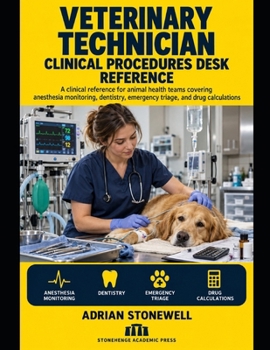
Veterinary Technician Clinical Procedures Desk Reference: A Point-of-Work System for Anesthesia, Dentistry, Emergency Triage, Calculations, Controlled Substances, and Practice Readiness

Veterinary Technician Clinical Procedures Desk Reference is an operational reference for credentialed and student technicians, technician supervisors, veterinary assistants, and practice trainers. It organizes recurring clinical-support work into quick-reference tables, procedures, calculation methods, escalation paths, checklists, logs, and adaptable examples.
The book assumes the reader already has foundational clinical training and works under a licensed veterinarian. It does not replace veterinarian direction, state scope-of-practice rules, employer policy, or patient-specific judgment. It supplies structure for anesthesia support, dentistry, emergency triage, calculations, controlled-substance handling, records, and handoffs across shifts.
One authority-aware system across the technician workflowThe opening chapters establish the boundaries before any procedure tool is introduced. It separates veterinarian direction, state requirements, practice policy, and reference tools so staff can distinguish process from authority. State-variable delegation questions go into a scope and delegation matrix rather than universal rules.
Quick references for anesthesia monitoring, dentistry workflow, emergency triage, drug calculations, adverse-event escalation, pain assessment, and species considerationsProcedure SOPs for pre-anesthetic intake, monitoring, dentistry, emergency triage, recovery, calculations, delegation boundaries, and troubleshootingEquipment checks, calibration, recovery controls, discharge and referral communication, failure response, and setting adaptationsMedication and controlled-substance governance covering dispensing, reconciliation, discrepancy escalation, security, storage, audit, and multi-site useReview-ready records, shift handoffs, client communication, retention, inspection preparation, competency validation, metrics, and corrective actionA source-and-version register, update cycle, retired-tool register, quick references, reusable templates, and six fictional casesDesigned to show both the method and the evidenceEvery major tool appears first as a worked structure and again in blank, adaptable form. The six fictional cases span routine companion-animal work, a large-animal field variation, an anesthetic complication, a delegation question, a referral failure, and a records inspection, showing how the same discipline behaves as setting and risk change.
Numeric thresholds, state rules, dosage decisions, and other moving or patient-specific requirements are deliberately routed back to the current governing source. The book demonstrates calculation method and workflow structure, while real doses, delegation boundaries, and clinical decisions remain governed by the responsible authorities.
For teams that want one documented way to workThe value of a desk reference is not that it replaces judgment; it is that it makes routine decisions, handoffs, checks, and escalation paths easier to find and easier to teach. The book gives teams a shared format for turning recurring tasks into tools with owners, sources, review dates, quality checks, and retirement triggers, supporting consistency through staff turnover, cross-training, mixed species, field settings, and busy shifts.
Customer Reviews
ThriftBooks ® and the ThriftBooks ® logo are registered trademarks of Thrift Books Global, LLC
