


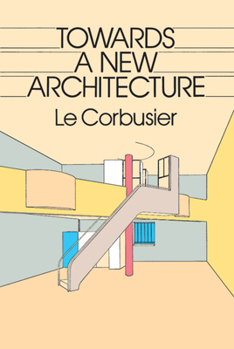
Towards a New Architecture


Select Format
Select Condition 
Book Overview
For the Swiss-born architect and city planner Le Corbusier (Charles-douard Jeanneret, 1887-1965), architecture constituted a noble art, an exalted calling in which the architect combined plastic invention, intellectual speculation, and higher mathematics to go beyond mere utilitarian needs, beyond "style," to achieve a pure creation of the spirit which established "emotional relationships by means of raw materials." The first major exposition of his ideas appeared in Vers une Architecture (1923), a compilation of articles originally written by Le Corbusier for his own avant-garde magazine, L'Esprit Nouveau . The present volume is an unabridged English translation of the 13th French edition of that historic manifesto, in which Le Corbusier expounded his technical and aesthetic theories, views on industry, economics, relation of form to function, the "mass-production spirit," and much else. A principal prophet of the "modern" movement in architecture, and a near-legendary figure of the "International School," he designed some of the twentieth century's most memorable buildings: Chapel at Ronchamp; Swiss dormitory at the Cit Universitaire, Paris; Unit d'Habitation, Marseilles; and many more. Le Corbusier brought great passion and intelligence to these essays, which present his ideas in a concise, pithy style, studded with epigrammatic, often provocative, observations: "American engineers overwhelm with their calculations our expiring architecture." "Architecture is stifled by custom. It is the only profession in which progress is not considered necessary." "A cathedral is not very beautiful . . ." and "Rome is the damnation of the half-educated. To send architectural students to Rome is to cripple them for life." Profusely illustrated with over 200 line drawings and photographs of his own works and other structures he considered important, Towards a New Architecture is indispensable reading for architects, city planners, and cultural historiansbut will intrigue anyone fascinated by the wide-ranging ideas, unvarnished opinions, and innovative theories of one of this century's master builders.
Format:Paperback
Language:English
ISBN:0486250237
ISBN13:9780486250236
Release Date:February 1985
Publisher:Dover Publications, Incorporated
Length:320 Pages
Weight:1.00 lbs.
Dimensions:0.6" x 6.1" x 9.2"
Customer Reviews
5 ratings
Great book!!
Published by Thriftbooks.com User , 18 years ago
Great Book!! It has a very detail description from point of view and concept of Le Corbusier.
How buildings became boxes
Published by Thriftbooks.com User , 19 years ago
A must read for anyone with the least bit of interest in architecture.
Eye opening and excellent
Published by Thriftbooks.com User , 21 years ago
While known for at times overstating his case, Le Corbusier still makes a well-thought and passionate statement for the impact and value of architecture in the 20th (and now 21st century). The book is a fast, engaging read and frighteningly topical for something that was written almost a century ago.
Where it all began
Published by Thriftbooks.com User , 22 years ago
Probably the most important book in Modern Architecture. Certainly the most villified over the years, especially since the death of Le Corbusier. In it he laid the ground work for Modern Architecture, extolling the virtues of an architecture that was the product of the machine age rather than a pastiche of historical styles. Le Corbusier illustrated the principles which he felt should govern architecture, drawing from historical references such as the Parthenon, but stressing the need to come up with a new proportional system reflective of concrete construction. He had developed the Dom-ino system by this point and had designed a few villas along these lines. Included are wonderful sketches and models of his Citrohan House, which he hoped would be mass-produced like the automobile. He even approached the French car maker, Citroen, in this regard.He explored low-scale housing solutions based on what he called the "Honeycomb" principle, porous housing blocks that allowed light and air to pass through the buildings for better ventilation and more airy courtyards. He forsaw many of the environmental concerns architecture now faces, despite the many attacks to the contrary.Le Corbusier would reshape many of his ideas over time, but this book outlines his early view of architecture in the machine age, which led to the quote most often taken from this book, "a house is a machine for living." But, Le Corbusier saw it in much more human terms than his critics have.
Wonderfully written and illistrated
Published by Thriftbooks.com User , 27 years ago
Le Corbousier's mathematical and, at times, brutal approach to architecture is clearly and coherently laid out in this gem of a book. He is very to the point and uses words and ideas that can plainly be understood by his audience. This book is not as bad as some people say it is - Le Corbousier's just not a romantic like the rest of us!
Copyright © 2026 Thriftbooks.com
Terms of Use | Privacy Policy | Do Not Sell/Share My Personal Information | Cookie Notice | Cookie Preferences | Accessibility Statement
ThriftBooks ® and the ThriftBooks ® logo are registered trademarks of Thrift Books Global, LLC
