


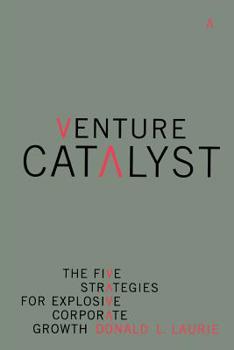
Venture Catalyst: The Five Strategies for Explosive Corporate Growth


In today's high-stakes environment, the question is not whether to venture but how far and fast can your company grow through new business creation. In Venture Catalyst, Don Laurie offers an insider's perspective on the explosive world of corporate venturing through interviews with such pioneers as former Corning Chairman Roger Ackerman, David Wetherell of CMGI, and Mitch Kapor of Accel. Moreover, he offers a practical framework for identifying new sources of growth, launching and managing ventures, balancing the tension between established discipline and entrepreneurial creativity, and maximizing the value of ventures. For executives, managers, entrepreneurs, and investors alike, Venture Catalyst is a powerful guide to thriving in the volatile new economy.
Format:Paperback
Language:English
ISBN:0738207764
ISBN13:9780738207766
Release Date:September 2002
Publisher:Basic Books
Length:288 Pages
Weight:0.94 lbs.
Dimensions:0.9" x 6.1" x 8.8"
Age Range:18 years and up
Grade Range:Postsecondary and higher
Customer Reviews
1 rating
Venture Strategies to Accelerate Revenue and Profit Growth
Published by Thriftbooks.com User , 24 years ago
From 1955 through 1998, only a handful of the largest U.S. companies were able to enjoy compounded double digit growth. These few include 3M, American International Group, Dayton Hudson, Hewlett Packard, PepsiCo, Procter & Gamble, UPS, and Wal-Mart. For most of those years, inflation was low so double-digit revenue growth meant major expansion in unit volume. The problem of finding revenue growth has been most severe for the Fortune 50. They have been lucky to match inflation. Management consultant and early stage investor Donald Laurie argues that a variety of venture-based strategies can perk up the growth rates of even the largest companies. You can invent the next great business (as Thermo Electron and Corning did in the 1990s), invest in the next great business (as Intel Capital and GE Equity did in the latter part of the 1990s), venture the next great business (as Nortel and Advent International), partner in the next great business (as Sperry Marine did with XL Vision), or acquire and integrate the next great business (as Cisco Systems did to build their lead in network architecture). In describing these choices, Mr. Laurie describes a business model as "the way a venture or venture strategy makes money." The most persuasive example in the book is that of Johnson & Johnson, which has successfully used all of these methods for many years.Each of the styles of establishing the next great business comes with questions to focus on to help you become effective in these areas. There's a lot of learning and expense involved, so don't look for quick fixes from this direction. I was particularly impressed by the description of how Corning invented its fiber optic business versus how Thermo Electron built its many new technologies. Each used a quite different approach. So, it's clear that there are many viable routes to pursuing these directions. You do, however, have to be sure that you pick one that fits what you can accomplish.Running ventures and operating existing, profitable businesses are two entirely different activities in time frames, objectives, and focus. Venture Catalyst does a nice job of making that point. In fact, this aspect of the book is a good adjunct to The Innovator's Dilemma. I must quibble with one aspect of the book. Venture Catalyst makes it all sound reasonably easy to do. My impression is that hardly any large companies have done well with their venture stage investments over the long run. Also, there are dozens of companies who find that their partnerships have severe problems for the few who master doing this well. Often, even those who do it well have a hard time explaining how they make them work. As the Innovator's Dilemma points out, inventing the next great business very rarely occurs from among the industry leaders. On the other hand, a number of people have been successful with acquiring and integrating promising technology-based businesses. But more large companies falter than succeed
Copyright © 2026 Thriftbooks.com
Terms of Use | Privacy Policy | Do Not Sell/Share My Personal Information | Cookie Policy | Cookie Preferences | Accessibility Statement
ThriftBooks ® and the ThriftBooks ® logo are registered trademarks of Thrift Books Global, LLC
ThriftBooks ® and the ThriftBooks ® logo are registered trademarks of Thrift Books Global, LLC
