
Skip to content
Scan a barcode
Scan
Paperback Veiled Empire: Gender and Power in Stalinist Central Asia Book

ISBN: 0801488915

ISBN13: 9780801488917

Veiled Empire: Gender and Power in Stalinist Central Asia

Select Format

Select Condition ThriftBooks Help Icon

Recommended

Format: Paperback

Condition: Acceptable

$10.89
Save $33.06!
List Price $43.95
Almost Gone, Only 1 Left!
Save to List

Book Overview

Drawing on extensive research in the archives of Russia and Uzbekistan, Douglas Northrop here reconstructs the turbulent history of a Soviet campaign that sought to end the seclusion of Muslim women. In Uzbekistan it focused above all on a massive effort to eliminate the heavy horsehair-and-cotton veils worn by many women and girls. This campaign against the veil was, in Northrop's view, emblematic of the larger Soviet attempt to bring the proletarian revolution to Muslim Central Asia, a region Bolsheviks saw as primitive and backward. The Soviets focused on women and the family in an effort to forge a new, "liberated" social order.This unveiling campaign, however, took place in the context of a half-century of Russian colonization and the long-standing suspicion of rural Muslim peasants toward an urban, colonial state. Widespread resistance to the idea of unveiling quickly appeared and developed into a broader anti-Soviet animosity among Uzbeks of both sexes. Over the next quarter-century a bitter and often violent confrontation ensued, with battles being waged over indigenous practices of veiling and seclusion.New local and national identities coalesced around these very practices that had been placed under attack. Veils became powerful anticolonial symbols for the Uzbek nation as well as important markers of Muslim propriety. Bolshevik leaders, who had seen this campaign as an excellent way to enlist allies while proving their own European credentials as enlightened reformers, thus inadvertently strengthened the seclusion of Uzbek women--precisely the reverse of what they set out to do. Northrop's fascinating and evocative book shows both the fluidity of Central Asian cultural practices and the real limits that existed on Stalinist authority, even during the ostensibly totalitarian 1930s.

Customer Reviews

1 rating

moral relativism but wonderful work

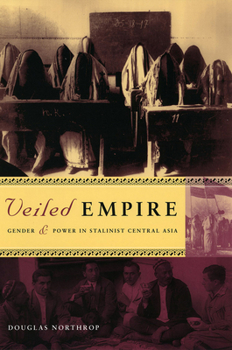
This wonderful insightful and original study tells the story of Communism and its relation with regressive Islamic attitudes in Central Asia, especially towards women. This tells the story of Communism's tentative strides towards making its Central Asian empire one of equality while at the same time trying to encourage ethnic individualism. Communism had railed against the Tsar's empire, thus when it came into contact with the Steppe peoples of Central Asia, mostly of ethnic Mongolian stock who had recently been converted to Islam and where women were required to wear long heavy veils(as evidenced by the wonderful photo on the cover and within). The Communists had a two track approach. On the one hand they continued their ethnic encouragements to create separate republics out of the tribal material. Yet at the same time Communists opened schools for women, enrolled girls for the first time, taught women to read, and within a short time had even trained the first Uzbek female patrooper. These successes were coupled with `veil burning' events where women would be protected by tough honorable communist youth as they burned the symbols of their oppression. But this sparked protest, ethnic and religious. The author weaves a wonderful story, the book is full of replete moral equivalency, so the Russians who are liberators of women are also seen as `imperialists' somehow suppressing a culture, but if one reads between the lines they will see that the pictures alone show the truth of Communisms crusade to bring equal rights to Asia. The process has reversed itself today, but for a short time in the 1920s idealism triumphed and women could walk down the street with their hair flowing proudly behind them, no longer confined to anonymity behind a Burka. A must read for anyone, Seth J. Frantzman
Copyright © 2026 Thriftbooks.com Terms of Use | Privacy Policy | Do Not Sell/Share My Personal Information | Cookie Policy | Cookie Preferences | Accessibility Statement
ThriftBooks® and the ThriftBooks® logo are registered trademarks of Thrift Books Global, LLC

GoDaddy Verified and Secured