


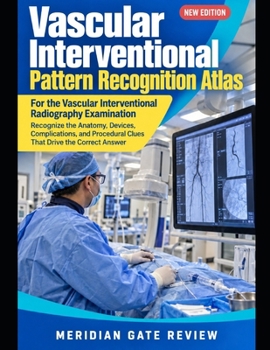
VASCULAR INTERVENTIONAL PATTERN RECOGNITION ATLAS: RECOGNIZE THE ANATOMY, DEVICES, COMPLICATIONS, AND PROCEDURAL CLUES THAT DRIVE THE CORRECT ANSWER

Vascular interventional questions become harder when anatomy, access, imaging, equipment, patient status, and complications are studied as separate lists. Relationships drive the decision: anatomy determines access, access changes catheter travel, device function must match the task, and imaging can confirm progress or expose a problem. A sudden patient change can shift priority to complication response.
This atlas trains the reader to find the decisive clue before selecting an action. Identify the decision point, isolate the decisive fact, name the governing rule, and eliminate choices that belong to another territory, function, sequence, or complication.
Match Equipment by Function, Not by BrandThe device library is organized around what the tool actually accomplishes. Guidewires provide navigation and exchange support; catheters select vessels or deliver contrast or therapy; balloons dilate; stents scaffold; embolic agents reduce targeted flow; thrombectomy systems remove clot; drains evacuate collections; sheaths maintain access; and closure devices manage the arteriotomy.
Patient readiness, laboratory context, monitoring, sedation, contrast reactions, asepsis, and emergency patternsFluoroscopy, DSA, roadmapping, image quality, geometry, radiation management, and dose-aware decisionsArterial, venous, portal, central, and peripheral anatomy for access and catheter navigationAngioplasty, stenting, embolization, thrombolysis, thrombectomy, atherectomy, filters, retrieval, and TIPSCentral venous access, dialysis procedures, and post-access or post-intervention complicationsRenal, biliary, enteric, pleural, spinal, biopsy, drainage, and ablation pathwaysRecognize the Moment the Procedure Stops Being RoutineComplication questions are approached as changes from the expected trajectory. Expanding swelling, hypotension, loss of a distal pulse, dyspnea, neurologic change, extravasation, sudden pain, or altered pressure can outrank the original indication. The review links each warning pattern to its plausible procedural source and the priority response.
Five Full Practice Exams Progress Beyond RecognitionThe 100-question tests move from classification into sequence, workflow, applied decisions, exceptions, and integrated cases. Later questions may ask whether the tool fits the vessel, whether the image proves the intended result, or whether a complication changes the next step.
Teaching rationales make each decision reusable. They identify the governing principle, explain why distractors fail, and preserve a compact rule for later retrieval. Mastery dashboards and retakes organize misses by patient care, image production, anatomy, access, devices, procedures, complications, and workflow.
Finish With a High-Value Retrieval SystemThe final command center consolidates anatomy maps, device matrices, procedure comparisons, monitoring relationships, radiation rules, and complication cues. It supports targeted review after practice tests identify weak relationships.
This is an independent educational resource for candidates preparing for the ARRT Vascular Interventional Radiography examination. It is not sponsored, endorsed, authorized, or published by ARRT. Procedures, devices, medications, contrast agents, radiation practices, and examination specifications can change; clinical work must follow applicable professional standards, manufacturer instructions, law, institutional protocols, supervision, and patient-specific judgment.
Customer Reviews
ThriftBooks ® and the ThriftBooks ® logo are registered trademarks of Thrift Books Global, LLC
