


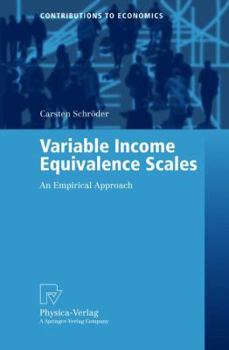
Variable Income Equivalence Scales: An Empirical Approach
No Customer Reviews

1.1 A Brief Overview An extensive body of empirical and theoretical literature deals with the mea- surement of social welfare. This body can be decomposed in several different but related topics, all of which have implications for empirical studies in wel- fare economics. One of these topics are household equivalence scales which help to compare welfare levels across households that differ in composition. An equivalence scale relates the income of any arbitrary household type to the income ofa referencehouseholdsuch that both households are equally well-off. Differences in household needs arise from differences in the households' de- mographic composition which is, for instance, given by the number, age, and sex of the household members. The increase of household needs is not neces- sarily proportional to the increase in the number of household members. Such a non-proportionality, for example, results from differences in the needs of adults and children, economies ofscale arising from the division of fixed costs among the household members, welfare gains from household production, and from common consumption ofcommodities bearing a within-household public good component.
Format:Paperback
Language:English
ISBN:3790801836
ISBN13:9783790801835
Release Date:March 2004
Publisher:Physica-Verlag
Length:168 Pages
Weight:0.57 lbs.
Dimensions:0.4" x 6.1" x 9.2"
Customer Reviews
0 rating
Copyright © 2026 Thriftbooks.com Terms of Use
| Privacy Policy | Do Not
Sell/Share My Personal Information | Cookie Policy | Cookie Preferences | Accessibility Statement
ThriftBooks® and the ThriftBooks® logo are registered trademarks of Thrift Books Global, LLC
ThriftBooks® and the ThriftBooks® logo are registered trademarks of Thrift Books Global, LLC
