


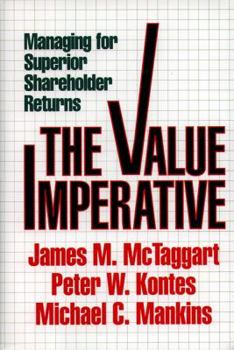
Value Imperative: Managing for Superior Shareholder Returns


Select Format
Select Condition 
Book Overview
Moving beyond the strategies that managers have employed to create shareholder value -- now the standard for business performance -- management experts James McTaggart, Peter Kontes, and Michael Mankins reveal their powerful new framework for the systematic, day-to-day management of shareholder value. The authors attack head-on the fundamental weaknesses in current management practices, namely, the stranglehold that budgeting has over strategic planning and the lack of imagination in management plans that prevents real changes and consequences. They provide a systematic approach to "value based management" that eliminates these weaknesses, offering proven strategies for managing large, complex companies to consistently produce superior results for stockholders.
Building on more than 16 years of consulting experience with many of the largest and best-known companies in North America, Europe, and Australia, the authors delineate the fundamental principles of value creation, as well as the primary obstacles. Starting with the principle that "cash flows drive value," McTaggart, Kontes, and Mankins show how to create a single governing objective that will enable managers to make decisions most likely to increase the company's competitive, organizational, and financial strength. Building on the objective of maximizing shareholder value, they outline the value based management framework that directly links a company's strategies and organization to its value in capital markets. Using real-world examples, they describe how to develop business and corporate strategies that substantially improve competitive position and increase market value, often within only two to five years. And as most large companies lack the internal processes necessary to manage for value on a sustained basis, the authors show managers how to build the five key processes that are institutional value drivers: governance, strategic planning, resource allocation, performance management, and top management compensation. Mastering these capabilities is fundamental to the ongoing, consistent creation of shareholder value over time.
All companies, the authors argue, inherently possess an enormous potential to create higher value for their shareholders. With hundreds of examples of companies that have successfully employed the beliefs, principles, and practices of value based management, this book shows general managers how to generate superior returns and realize their business's full value potential.
Building on more than 16 years of consulting experience with many of the largest and best-known companies in North America, Europe, and Australia, the authors delineate the fundamental principles of value creation, as well as the primary obstacles. Starting with the principle that "cash flows drive value," McTaggart, Kontes, and Mankins show how to create a single governing objective that will enable managers to make decisions most likely to increase the company's competitive, organizational, and financial strength. Building on the objective of maximizing shareholder value, they outline the value based management framework that directly links a company's strategies and organization to its value in capital markets. Using real-world examples, they describe how to develop business and corporate strategies that substantially improve competitive position and increase market value, often within only two to five years. And as most large companies lack the internal processes necessary to manage for value on a sustained basis, the authors show managers how to build the five key processes that are institutional value drivers: governance, strategic planning, resource allocation, performance management, and top management compensation. Mastering these capabilities is fundamental to the ongoing, consistent creation of shareholder value over time.
All companies, the authors argue, inherently possess an enormous potential to create higher value for their shareholders. With hundreds of examples of companies that have successfully employed the beliefs, principles, and practices of value based management, this book shows general managers how to generate superior returns and realize their business's full value potential.
Format:Hardcover
Language:English
ISBN:0029206707
ISBN13:9780029206706
Release Date:March 1994
Publisher:Free Press
Length:367 Pages
Weight:1.56 lbs.
Dimensions:1.4" x 6.4" x 9.6"
Customer Reviews
5 ratings
Required Reading for Private Equity Investors
Published by Thriftbooks.com User , 19 years ago
A description of the importance of defining and emphasizing "best practice" to efficiently direct the business activities of any size organization and explanations about disruptive technologies. A strong description of "the value based" approach to management.
The Bible
Published by Thriftbooks.com User , 23 years ago
I consider this book the bible of all books on value creation and how to achieve it. It is eminently practical and should be on every financial practitioner's bookshelf. I also recommend reading it annually. It is a wonderful compliment to the other value-based managment books in the market which tend to go long on theory. They're also excellent; but this combines value-based managment and strategy superbly.
Good for understanding how to create shareholder value
Published by Thriftbooks.com User , 25 years ago
Good ideas for day-to-day management to manage value as well as big ideas for strategy. There were interesting section on how budgeting strangles strategic planning and what to do with about it. I think this is a great book for executives managing large companies in mature industries. It shows how to focus on value creation at every level of the organization. It gave advice on how to take action and achieve results.
The Value Imperative is a WINNER!!
Published by Thriftbooks.com User , 26 years ago
The Value Imperative offers a great framework for managing for value. This book should be read by all corporate executives. It starts with the fundamentals on how value is created and links value creation to business strategy. The authors vividly explain how business can create value by employing a number of different competitive strategies. The final part of the book pulls everything together and focuses on the role of the corporate center in managing various business units and allocating resources.
An excellent, down-to-earth guide for corporate managers
Published by Thriftbooks.com User , 27 years ago
A lot of books have been published on value based management, or managing to maximize shareholder value, but this is the best I've seen on several counts. First, it emphasizes process throughout: taking the corporate manager from governing objective to the nitty-gritty of individual business units, and showing at each step how decisions should be made to produce the best possible return."Value Imperative" addresses some issues I haven't seen discussed sufficiently in other books of this genre: most specifically, how to produce top value when you're operating in a low-growth or no-growth industry, and precisely what sort of managerial compensation structure fits best into a VBM framework. In every case, the authors' prescriptions are logical and understandable. Most importantly, they encourage the reader to believe that their solutions and disciplines are doable - challenging, but achievable.Some management books strangle on theory and mathematical analysis, but this one doesn't - another reason I liked it. The authors keep the math - solid and useful analytics - in the appendices, while, again, the main text emphasizes process at the human level. What one sees mainly by way of illustration are flow charts which help make the VBM approach clear.Encouragingly, nothing they write here seems dated -- although it originally apeared in 1994, "Value Imperative's" lessons apply to companies facing a slower-growing economy (as we may be now)as well as those in a fast-growing environment.This book would seem best for large companies in mature industries, rather than start-ups, although some of its lessons may be good for the latter as well. It contains a lot of good case study material, and should be especially useful to companies that are reevaluating their commitment to some lines of business, looking atpotential acquisitions or divestments, revamping their compensation policy, or considering pouring a lot of resources into aggressively growing a particular sector (it's especially critical of "patient money" and "economy of scale" arguments for growth). Managers who want to read something about their practice that's solid, practical, and not faddish should take a look.
Copyright © 2026 Thriftbooks.com Terms of Use
| Privacy Policy | Do Not
Sell/Share My Personal Information | Cookie Policy | Cookie Preferences | Accessibility Statement
ThriftBooks® and the ThriftBooks® logo are registered trademarks of Thrift Books Global, LLC
ThriftBooks® and the ThriftBooks® logo are registered trademarks of Thrift Books Global, LLC
