


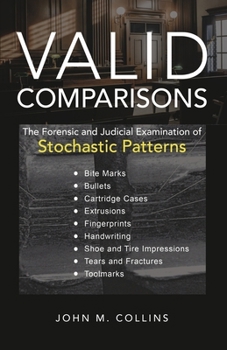
Valid Comparisons: The Forensic and Judicial Examination of Stochastic Patterns
No Customer Reviews

When a bullet exits a gun, a fingerprint is left on a surface, or a signature is forged, the physical traces left behind become the only witnesses to events that unfolded in secrecy. For more than a century, forensic examiners have learned to read these patterns--to interpret them consistently, carefully, and with consequences that can mean the difference between justice and its failure. Forensic patterns are often a final scientific record of real lives, examined by professionals whose work carries a weight that few outside the discipline fully appreciate.
In Valid Comparisons, John M. Collins draws on more than three decades of experience at the intersection of forensic science and the American justice system to deliver a rigorous, unflinching examination of what has gone wrong--and what must be corrected--in the courtroom treatment of forensic pattern evidence.
Forensic pattern analysis, which encompasses fingerprints, toolmarks, firearms, handwriting, footwear impressions, and other stochastic evidence, has been subjected to decades of systematic mischaracterization. Much of it originated not from science, but from a misreading of a Supreme Court ruling that became, in Collins's memorable phrase, a contagion--spreading doubt, discrediting testimony, and emboldening critics whose agendas had less to do with truth than with outcome. What began as a legal framework for evaluating expert testimony was weaponized into an instrument of institutional skepticism, one that has since compromised the standing of reliable evidence and, with it, the integrity of the proceedings that depend on it.
Valid Comparisons challenges that narrative directly. With clarity and authority, Collins examines the use of forensic patterns from the ground up--explaining what they are, why they form, and why their individuality is not a matter of assumption but of scientific principle. He traces the legal history that shaped their courtroom treatment, from the Frye standard to Daubert and the rule changes that followed, and he identifies precisely where interpretation gave way to misrepresentation. He scrutinizes the institutional reports and advocacy campaigns that have shaped public and judicial perception of forensic science, assessing them not by their intentions but by the quality of their evidence and reasoning.
This is a book that attacks difficult questions head-on. Collins examines the concept of error, the truth about human bias, the limits of standardization, and the vulnerabilities that arise when professional judgment is poorly exercised or inadequately supervised. He addresses the "junk science" narrative that has attached itself to pattern disciplines and dismantles it methodically, distinguishing between legitimate reform and ideologically driven revisionism. He also takes a probing look at the institutions, advocates, and expert witnesses who bear the greatest responsibility for the current state of affairs--and for its correction. Valid Comparisons is carefully reasoned - grounded in science, law, and professional experience - returning forensic pattern evidence to its rightful place of respect in the pursuit of justice. It is also a call to accountability--for forensic scientists who must exercise their expertise with discipline and humility, for attorneys and judges who must evaluate that expertise with sophistication, and for institutions that have too often prioritized narrative over rigor.
Valid Comparisons is essential reading for forensic scientists, attorneys, judges, investigators, and anyone who believes that the search for truth in a courtroom demands the best science available--interpreted honestly, presented clearly, and defended without apology.
In Valid Comparisons, John M. Collins draws on more than three decades of experience at the intersection of forensic science and the American justice system to deliver a rigorous, unflinching examination of what has gone wrong--and what must be corrected--in the courtroom treatment of forensic pattern evidence.
Forensic pattern analysis, which encompasses fingerprints, toolmarks, firearms, handwriting, footwear impressions, and other stochastic evidence, has been subjected to decades of systematic mischaracterization. Much of it originated not from science, but from a misreading of a Supreme Court ruling that became, in Collins's memorable phrase, a contagion--spreading doubt, discrediting testimony, and emboldening critics whose agendas had less to do with truth than with outcome. What began as a legal framework for evaluating expert testimony was weaponized into an instrument of institutional skepticism, one that has since compromised the standing of reliable evidence and, with it, the integrity of the proceedings that depend on it.
Valid Comparisons challenges that narrative directly. With clarity and authority, Collins examines the use of forensic patterns from the ground up--explaining what they are, why they form, and why their individuality is not a matter of assumption but of scientific principle. He traces the legal history that shaped their courtroom treatment, from the Frye standard to Daubert and the rule changes that followed, and he identifies precisely where interpretation gave way to misrepresentation. He scrutinizes the institutional reports and advocacy campaigns that have shaped public and judicial perception of forensic science, assessing them not by their intentions but by the quality of their evidence and reasoning.
This is a book that attacks difficult questions head-on. Collins examines the concept of error, the truth about human bias, the limits of standardization, and the vulnerabilities that arise when professional judgment is poorly exercised or inadequately supervised. He addresses the "junk science" narrative that has attached itself to pattern disciplines and dismantles it methodically, distinguishing between legitimate reform and ideologically driven revisionism. He also takes a probing look at the institutions, advocates, and expert witnesses who bear the greatest responsibility for the current state of affairs--and for its correction. Valid Comparisons is carefully reasoned - grounded in science, law, and professional experience - returning forensic pattern evidence to its rightful place of respect in the pursuit of justice. It is also a call to accountability--for forensic scientists who must exercise their expertise with discipline and humility, for attorneys and judges who must evaluate that expertise with sophistication, and for institutions that have too often prioritized narrative over rigor.
Valid Comparisons is essential reading for forensic scientists, attorneys, judges, investigators, and anyone who believes that the search for truth in a courtroom demands the best science available--interpreted honestly, presented clearly, and defended without apology.
Format:Paperback
Language:English
ISBN:B0GY2GV896
ISBN13:9798317839437
Release Date:June 2026
Publisher:BookBaby
Length:424 Pages
Weight:1.27 lbs.
Dimensions:8.5" x 1.0" x 5.5"
Related Subjects
LawCustomer Reviews
0 rating
Copyright © 2026 Thriftbooks.com
Terms of Use | Privacy Policy | Do Not Sell/Share My Personal Information | Cookie Policy | Cookie Preferences | Accessibility Statement
ThriftBooks ® and the ThriftBooks ® logo are registered trademarks of Thrift Books Global, LLC
ThriftBooks ® and the ThriftBooks ® logo are registered trademarks of Thrift Books Global, LLC
