


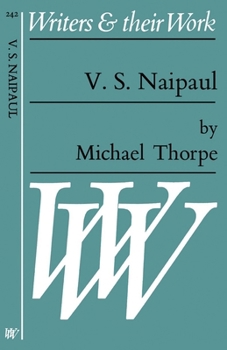
V.S. Naipaul
No Customer Reviews

V. S. Naipaul (1932-2018), born in Trinidad of Indian parents before moving to Britain, defeated the attempts of critics to attach him to a particular belief, society, place, or race. Freed by immigration, he can aspire to a certain universality, using the human condition as his subject-matter; on the other hand, like so many of his central characters, he is free only in the sense of drifting, and the mainly comic mood of his earlier novels is overlaid in his later work by the sadness and realization of rootlessness. In this 1976 study, Michael Thorpe traces Naipaul's development and growth in stature as a novelist who is now recognized as being in a class by himself among Caribbean writers.
Format:Paperback
Language:English
ISBN:0582012449
ISBN13:9780582012448
Release Date:August 1976
Publisher:Liverpool University Press
Length:54 Pages
Customer Reviews
0 rating
Copyright © 2026 Thriftbooks.com Terms of Use
| Privacy Policy | Do Not
Sell/Share My Personal Information | Cookie Policy | Cookie Preferences | Accessibility Statement
ThriftBooks® and the ThriftBooks® logo are registered trademarks of Thrift Books Global, LLC
ThriftBooks® and the ThriftBooks® logo are registered trademarks of Thrift Books Global, LLC
