


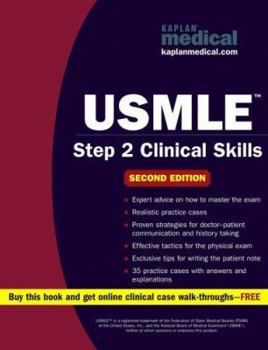
USMLE Step 2 Clinical Skills

The USMLE Step 2 Clinical Skills Qbook Features: Expert advice on how to master the CS exam; Realistic practice cases; Proven strategies for doctor-patient communication, history taking, they physical... This description may be from another edition of this product.
Format:Paperback
Language:English
ISBN:0743273451
ISBN13:9780743273459
Release Date:August 2005
Publisher:Kaplan Publishing
Length:320 Pages
Weight:1.65 lbs.
Dimensions:10.8" x 0.8" x 8.4"
Customer Reviews
2 ratings
great book
Published by Thriftbooks.com User , 17 years ago
great book. there are just too many empty pages for the notes and I feel it would be better to have more cases in the book than more empty pages. however the cases they have are good and very useful.
Real insider information on the policy of scoring in Clinical Skills.
Published by Thriftbooks.com User , 19 years ago
This is an invaluable source on explaining how credit is granted or denied during the twelve case encounters of the CS. The book prepares the tested clinician along the various phases of each encounter, as follows: 1- Initial Differential Diagnosis: ---------------------------- - Hypothesizing a triad of differential diagnosis on reading the encounter's fact sheet, at the door step. - Starting from the fact sheet, the tested clinician should formulate a triad of differential diagnosis based on the chief complaint. - There are 7 generic complaints: headache, cough, chest pain, abdominal pain, fatigue, depression, and fever. - Those should lead to suggested differential diagnosis based on age, blood pressure, fever, and mode of onset. - Before knocking on the encounter's door, the list of differential diagnosis must be determined. 2- Doctor-Patient Rapport: -------------------------- - Addressing the patient in various circumstances: calm, pain, anger, and disabled. - Focusing on patient's narration, appearance, and feeling. - Standardized responses to common patients' inquiries: request for medication, fear of death, seeking quick diagnosis,.... - Prelude to each transition, closing, and summarizing. - Credit denial: main system of examination is not examined thoroughly, encounter sought explanation and never got it, encounter not covered before exam, examining through gown, encountered assured prematurely, or specific basic question was not asked. 3- Focused History of Present Illness: ------------------------------------- - No leading, only inquiring questions earn you credit. - Paraphrasing and summarizing further ensures your correct gathering of info. - From the triad of differential diagnosis, the history taking must center on sorting those out. - History entails 8 specific items: site, intensity, quantity, quality, onset, radiation, aggravation, and association. - The 8 items entail the present illness, family, lifestyle, and sexual history. 4- Focused Physical Exam: ------------------------- - Kaplan is great in describing the specific system for each differential diagnosis. - Headache leads to neural and special senses exam. - Fever leads to respiratory or digestive exam. - Local pain leads to local exam (joint, heart, abdomen). - Fatigue leads to endocrine and general inspection. 5- Closing: ---------- - Summing up your finding of history and exam. - Sharing diagnosis and lab tests. - Answering questions. 6- Patient's Note: ----------------- - That turns to be a breeze since the differential diagnosis was established 15 minutes earlier. - The history should cover the 8 specific items. - The physical exam covers the specific systems in relation to the differential diagnosis. - The lab tests should sort out the differential diagnosis. Drawback: --------- There is no list of common medical abbreviations. If you forgot what JVD or CVA is, you would not get quick help from Kaplan. It took me a while to figure
Copyright © 2026 Thriftbooks.com
Terms of Use | Privacy Policy | Do Not Sell/Share My Personal Information | Cookie Policy | Cookie Preferences | Accessibility Statement
ThriftBooks ® and the ThriftBooks ® logo are registered trademarks of Thrift Books Global, LLC
ThriftBooks ® and the ThriftBooks ® logo are registered trademarks of Thrift Books Global, LLC
