


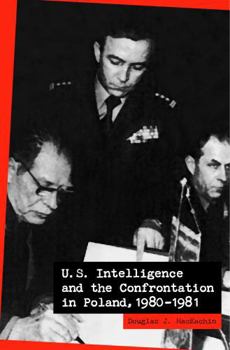
U.S. Intelligence and the Confrontation in Poland, 1980–1981
No Customer Reviews

Select Format
Select Condition 
Book Overview
Despite the U.S. government's sophisticated intelligence capabilities, policy makers repeatedly seemed to be caught off guard when major crises took place during the Cold War. Were these surprises the result of inadequate information, or rather the use made of the information available? In seeking an answer to this question, former CIA analyst Douglas MacEachin carefully examines the crisis in Poland during 1980-81 to determine what information the U.S. government had about Soviet preparations for military intervention and the Polish regime's plans for martial law, and what prevented that information from being effectively employed Drawing on his experience in intelligence reporting at the time, as well as on recently declassified U.S. documents and materials from Soviet, Polish, and other Eastern European archives, MacEachin contrasts what was known then with what is known now, and seeks to explain why, despite the evidence available to them, U.S. policy makers did not take the threat of a crackdown seriously enough to prevent it. It was the mind-set of those who processed the information, not the lack or accuracy of information, that was the fundamental problem, MacEachin argues. By highlighting this cognitive obstacle, his analysis points the way toward developing practices to overcome it in the future.
Format:Hardcover
Language:English
ISBN:0271022108
ISBN13:9780271022109
Release Date:August 2002
Publisher:Penn State University Press
Length:268 Pages
Weight:1.00 lbs.
Dimensions:9.0" x 0.8" x 6.0"
Customer Reviews
0 rating
Copyright © 2026 Thriftbooks.com Terms of Use
| Privacy Policy | Do Not
Sell/Share My Personal Information | Cookie Policy | Cookie Preferences | Accessibility Statement
ThriftBooks® and the ThriftBooks® logo are registered trademarks of Thrift Books Global, LLC
ThriftBooks® and the ThriftBooks® logo are registered trademarks of Thrift Books Global, LLC
