


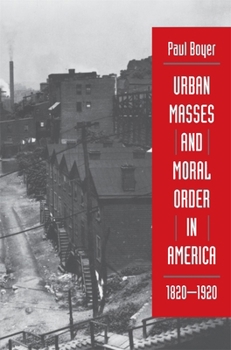
Urban Masses and Moral Order in America, 1820-1920

Select Format
Select Condition 
Book Overview
Revised
Format:Paperback
Language:English
ISBN:0674931106
ISBN13:9780674931107
Release Date:March 1992
Publisher:Harvard University Press
Length:432 Pages
Weight:1.38 lbs.
Dimensions:1.1" x 6.1" x 9.3"
Customer Reviews
1 rating
The Invasion of the "Friendly Visitor"
Published by Thriftbooks.com User , 24 years ago
Boyer's URBAN MASSES AND MORAL ORDER was a book just ahead of its time. In the Foucauldian spirtit of the historical genealogy which has become the standard form of books about social power, Boyer periodizes the many manifestations of social control that rose in American cities from 1820 to 1920. The first social control programs were the Tract Societies who distributed tracts showing new urban populations how to live morally, according to a kind of outdated bucolic Christian ideal. When tracts didn't work (none of the methods worked at all well according to Boyer), a number of other missionary societies stepped in with new ideas: the Children's Aid Society, the YMCA, the Salvation Army, the Settlement Movement, and finally, the City Beautiful Movement. Many of these societies went after children as the best hope for saving innocent urban unfortunates from the ills of the city, their ethnic parents, and the filthy Catholic and Jewish denizens of the tenements. The only exception was the Children's Aid Society whose founder saw urban urchins as extremely savvy, smart and supremely adaptive. Nonetheless, the Children's Aid Society shipped young people out to rural America in the belief that they could better prosper elsewhere than in the city. Most of the time this was done with parental consent, but sometimes kids claimed to be orphans so they could have an adventure with their friends. Boyer's largest theme is the tracing of slow retreast of the strategy of personal contacts with the urban poor rendered by the "friendly visitor" of these many organizations as the means for moral uplift and social control, and its eventual replacement by the notion that a new achitecture, a new environment of playgrounds, swimming pools, outdoor concerts would have a mass civilizing effect. The prosletyzing was done in the form of buildings and patrolled urban spaces. Sans the religion, but still full of the moralizing and improving rhetoric, the progressive age government was enlisted in these new strategies of social control. And, of course, eventually, the "friendly vistior" became the social worker. But the same goal was pursued -- turning scary immigrants into solid middle-class citizens. Positive resentimentalizaion through civil space, through education, through public art in public museums, etc., is still a major strategy in large cities. Art and high culture as a moral instrument. Boyer's other large theme is that all of these movements were essentially the same -- the tactics barely changed from generation to generation, with the exception of the spatial solution which had a different means but the same hoped for end. As one exhausted organization after another gave up, new organizations sprung to take their place, most of them presided over by men from rural communities who had moved to the city and were disturbed by the lack of social cohesion and surveillance they had experience growing up, and so sought to impose their rural or town Chris
Copyright © 2026 Thriftbooks.com
Terms of Use | Privacy Policy | Do Not Sell/Share My Personal Information | Cookie Policy | Cookie Preferences | Accessibility Statement
ThriftBooks ® and the ThriftBooks ® logo are registered trademarks of Thrift Books Global, LLC
ThriftBooks ® and the ThriftBooks ® logo are registered trademarks of Thrift Books Global, LLC
