


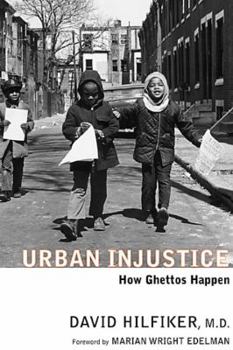
Urban Injustice: How Ghettos Happen


Select Format
Select Condition 
Book Overview
David Hilfiker has committed his life, both as a writer and a doctor, to people in need, writing about the urban poor with whom he's spent all his days for he last two decades. In this book, he explains in beautiful and simple language how the myth that the urban poor siphon off precious government resources is contradicted by the facts, and how most programs are not sufficiently orchestrated to enable people to escape the cycle of urban poverty. Making a clear path through the history of societal poverty, he draws on models from around the world to build a better world.
Format:Hardcover
Language:English
ISBN:1583224653
ISBN13:9781583224656
Release Date:September 2002
Publisher:Seven Stories Press
Length:176 Pages
Weight:0.80 lbs.
Dimensions:8.8" x 0.8" x 6.0"
Related Subjects
African-American Studies City Planning & Urban Development Historical Study & Educational Resources History Humanities Political Science Politics & Government Politics & Social Sciences Poverty Revolution & Founding Social History Social Science Social Sciences Sociology Specific Demographics UrbanCustomer Reviews
3 ratings
How Racism Created the Ghettos
Published by Thriftbooks.com User , 16 years ago
As a physician, David Hilfiker saw first hand the effects of crushing poverty on the black inner city poor. Rather than blame them for thier situation, he dove into the underlying problems and the deep seated racism that had created the ghettos. He handily demolishes many of the urban legends about the poor and builds a much different picture in it's place. For such a slim volume, this is a powerful work. I highly recommend it.
Book Review
Published by Thriftbooks.com User , 18 years ago
I bought this book for a psychology class I am taking and this book is very knowledgeable and easy to follow.
worth reading
Published by Thriftbooks.com User , 22 years ago
It is written by a doctor who has been working with innner city patients for over two decades. He understands their medical and psychosocial issues very well but he was puzzled by many things. Including, how is it that there is such sharp geographical clustering of poverty, how is this cycle perpetuated from one generation to the next, how does 'govt. assistance' work and how is it designed?He tried to find the answers by surveying the sociological, economic, and public policy literature. He describes his book as the type of resource he wished he had access to in medical school. The book itself is only about 130 pages (not including endnotes which were quite interesting). Anyway, I found it to be very interesting and it is totally readable in one sitting so busy people might like it.Because my understanding of what he was trying to explain is very unsophisitcated, I couldn't read the book with a critical eye (except one type where I'm quite sure he meant "integration" instead of "segregation" but that was just one word.) I do warn you that it isn't a cozy book (although it wasn't a screamin' shockin', bleedin' liberal tryst either, thank goodness). Just so you're prepared.
Copyright © 2026 Thriftbooks.com Terms of Use
| Privacy Policy | Do Not
Sell/Share My Personal Information | Cookie Policy | Cookie Preferences | Accessibility Statement
ThriftBooks® and the ThriftBooks® logo are registered trademarks of Thrift Books Global, LLC
ThriftBooks® and the ThriftBooks® logo are registered trademarks of Thrift Books Global, LLC
