


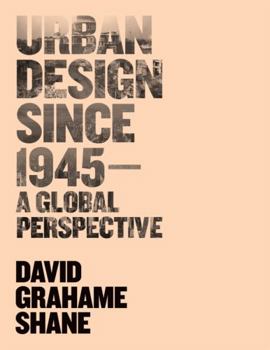
Urban Design Since 1945: A Global Perspective
No Customer Reviews

Urban Design Since 1945: A Global Perspective reviews the emergence of urban design as a global phenomenon. The book opens with the urgent need to rebuild cities and re-house the millions of refugees living in camps and shantytowns at the end of the Second World War. Against this background, the book traces the collapse of the modernist, comprehensive state-planning schemes on both sides of the Iron Curtain as global corporations emerged, concentrating on networks and enclaves. It describes how Latin America and then Asia began a rapid urbanisation process, shifting the global urban centre away from Europe and overturning existing urban design models. This resulted in global megacities of an unprecedented scale, often with large associated shantytowns.
By outlining the dominant models in urban design over the last sixty years - the metropolis, the megalopolis, the fragmented metropolis and the global megacity - the book provides an essential framework for students of the subject.
Featured case studies include:
the rebuilding of metropolitan capitals in Europe and Asia, such as Berlin, London, Moscow, Tokyo and Beijing the construction of new towns like Nowa Huta, Poland; Harlow, UK; Chandigarh, India; Brasilia, Brazil; Milton Keynes New Town, UK; and Shenzhen, China the megalopolis as a global phenomenon from the American East Coast, Texas, California, Arizona and Florida, with examples from Europe, the Middle East, Asia and Latin America, such as Caracas, Venezuela the fragmented metropolis as a global phenomenon, with American, Asian and European examples, such as Downtown and Midtown (New York), Shinjuku (Tokyo), Canary Wharf (London), La D fense (Paris) and Potsdamer Platz (Berlin) megacities as a global phenomenon, such as Jakarta in Indonesia or Bangkok in Thailand, that include urban agriculture and urban villages, as do shrinking eco-city regions such as Duisburg, Germany or Detroit, USA World's Fairs such as Brussels 1958 and Osaka 1970 which feature as drivers of innovation, as do Olympic events in Tokyo (1964), Barcelona (1992), Beijing (2008) and London (2012).Format:Paperback
Language:English
ISBN:0470515260
ISBN13:9780470515266
Release Date:June 2011
Publisher:Wiley
Length:360 Pages
Weight:2.00 lbs.
Dimensions:0.9" x 6.7" x 8.6"
Related Subjects
ArchitectureCustomer Reviews
0 rating
Copyright © 2025 Thriftbooks.com
Terms of Use | Privacy Policy | Do Not Sell/Share My Personal Information | Cookie Policy | Cookie Preferences | Accessibility Statement
ThriftBooks ® and the ThriftBooks ® logo are registered trademarks of Thrift Books Global, LLC
ThriftBooks ® and the ThriftBooks ® logo are registered trademarks of Thrift Books Global, LLC
