


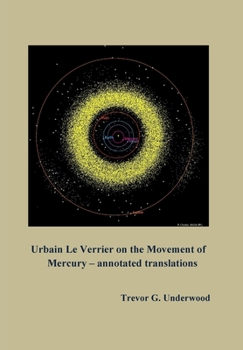
Urbain Le Verrier on the Movement of Mercury - annotated translations
No Customer Reviews

In 1916, Einstein proposed three tests of general relativity, subsequently called the "classical tests" of general relativity: - the perihelion precession of Mercury's orbit - the deflection of light by the Sun - the gravitational redshift of light. The key evidence on which Einstein relied to support his theory was the first of these, which related to unexplained errors in the observations of Mercury's orbit reported in 1859 by Urbain Le Verrier, the Director of the Paris Observatory. As the available publications that led to Le Verrier's claim, which were developed over a period of nearly two decades, were complex and only available in French, as part of a larger project, I translated them into English and annotated them, to make them easier to understand. As it appeared that this might be helpful to other researchers, I decided to publish my translations in the current volume. This book provides translations of two books, Le Verrier, U. -J. (1841), D?veloppements sur Plusieurs Points de la Th?orie des Perturbations des Plan?tes (Developments on several points of the Theory of Perturbations of Planets); and Le Verrier, U. -J. (1845), Th?orie du mouvement de Mecure (The Theory of the Movement of Mercury); and a 195-page article, Le Verrier, U. -J. (1859), Theorie du Mouvement de Mercure (The Theory of the Movement of Mercury), Chapter XV in the Annales de L'Observatoire Imp?rial de Paris. It also includes a translation of the 1859 letter in which Le Verrier reported his claim, Lettre de M. Le Verrier ? M. Faye sur la th?orie de Mercure et sur le mouvement du p?rih?lie de cette plan?te (Letter from M. Le Verrier to M. Faye on the theory of Mercury and on the perihelion movement of this planet), which was published in the Comptes rendus hebdomadaires des s?ances de l'Acad?mie des Sciences (Paris). The conclusions from this detailed review are that, rather than implying a systematic error in the calculated values, the steady reduction in the errors in the equations of condition could be seen to be a demonstration of a linear improvement in the accuracy of the measurements over time as one might expect, resulting in no adjustment to the elliptic elements, and no difference between the calculated rates of precession, and no support for Einstein's theory of general relativity.
Format:Hardcover
Language:English
ISBN:0578337177
ISBN13:9780578337173
Release Date:December 2021
Publisher:Trevor G. Underwood
Length:372 Pages
Weight:1.43 lbs.
Dimensions:0.9" x 6.0" x 9.0"
Customer Reviews
0 rating
Copyright © 2026 Thriftbooks.com Terms of Use
| Privacy Policy | Do Not
Sell/Share My Personal Information | Cookie Policy | Cookie Preferences | Accessibility Statement
ThriftBooks® and the ThriftBooks® logo are registered trademarks of Thrift Books Global, LLC
ThriftBooks® and the ThriftBooks® logo are registered trademarks of Thrift Books Global, LLC
