


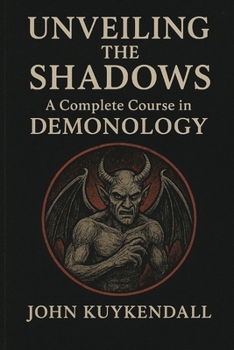
Unveiling the Shadows: A Complete Course in Demonology

What is Demonology?
Why study it?
Clarifying misconceptions (Hollywood vs. reality).
The role of belief, culture, and religion.
Part I - Foundations of Demonology
Chapter 1: The Origins of Demonology
Ancient Mesopotamian, Babylonian, and Egyptian roots.
Early concepts of spirits, gods, and malevolent beings.
Chapter 2: Demons Across Cultures
Jewish, Christian, Islamic views.
Eastern traditions (Hindu Rakshasas, Buddhist Mara, Japanese Oni).
African and Native spirit traditions.
Chapter 3: Theology and Demonology
Biblical references to demons.
Early Church Fathers and their teachings.
The evolution of Satan and "fallen angels."
Part II - Classification and Nature of Demons
Chapter 4: Hierarchies of Hell
Medieval grimoires (e.g., The Lesser Key of Solomon).
Ranking systems: Dukes, Princes, Kings.
Symbolism of demon names and seals.
Chapter 5: Characteristics of Demons
Appearance and forms.
Powers attributed to them.
Possession, oppression, and temptation.
Chapter 6: Demons vs. Other Spirits
Distinguishing demons from ghosts, poltergeists, and deities.
Folk spirits and regional differences.
Part III - Human Interaction with Demons
Chapter 7: Possession and Exorcism
Historical and modern documented cases.
Catholic and Orthodox rites of exorcism.
Psychological vs. spiritual interpretations.
Chapter 8: Witchcraft and Pacts
The demonization of witches.
Famous witch trials and confessions.
Pacts with demons (literature & belief).
Chapter 9: Signs of Demonic Influence
Traditional warnings.
Skeptical perspectives.
Modern paranormal investigation.
Part IV - The Study and Practice of Demonology
Chapter 10: Demonology in Occult Literature
Grimoires and forbidden books.
Aleister Crowley and modern occultists.
Satanism vs. Demonology.
Chapter 11: The Scholar's Approach
Research methods.
Separating myth from documented belief.
Cross-cultural comparison.
Chapter 12: Modern Relevance of Demonology
Pop culture's effect (movies, books, internet).
Demonology in paranormal investigation today.
Is there a place for Demonology in modern theology?
Conclusion
Summary of lessons.
Respecting spiritual beliefs.
The continuing mystery of darkness.
Customer Reviews
ThriftBooks® and the ThriftBooks® logo are registered trademarks of Thrift Books Global, LLC
