


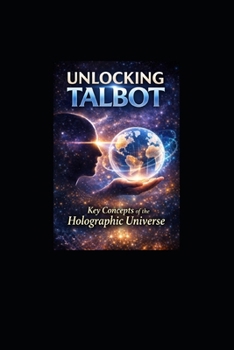
Unlocking Talbot: Key Concepts of the Holographic Universe

What if reality is not what it appears to be?
In the late twentieth century, writer Michael Talbot introduced readers to one of the most fascinating ideas in modern science. The possibility that the universe itself may function like a hologram.
Drawing inspiration from the work of physicist David Bohm and neuroscientist Karl Pribram, Talbot explored a radical model of reality in which the universe is structured through patterns of information. In this vision, everything in existence may be deeply interconnected, and the world we experience could represent the unfolding of deeper hidden structures.
Unlocking Talbot examines the key concepts behind this remarkable idea in clear and accessible language. This book explores the scientific inspirations that shaped the holographic universe theory and the profound questions it raises about consciousness, perception, and the nature of reality.
Inside this book you will discover
The origins of the holographic universe concept
The work of David Bohm and the implicate order
Karl Pribram's holographic brain theory
The role of consciousness in shaping perception
Quantum nonlocality and deep connections in the universe
The philosophical implications of an interconnected cosmos
Whether you are new to these ideas or already fascinated by the mysteries of consciousness and physics, this book offers a thoughtful introduction to one of the most intriguing models of reality ever proposed.
The universe may be far stranger and more interconnected than we ever imagined.
Customer Reviews
ThriftBooks ® and the ThriftBooks ® logo are registered trademarks of Thrift Books Global, LLC
