


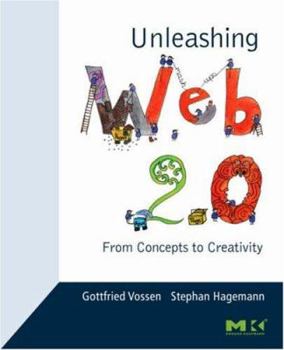
Unleashing Web 2.0: From Concepts to Creativity

Select Format
Select Condition 
Book Overview
The emergence of Web 2.0 is provoking challenging questions for developers: What products and services can our company provide to customers and employees using Rich Internet Applications, mash-ups,... This description may be from another edition of this product.
Format:Paperback
Language:English
ISBN:0123740347
ISBN13:9780123740342
Release Date:August 2007
Publisher:Morgan Kaufmann Publishers
Length:368 Pages
Weight:1.66 lbs.
Dimensions:0.9" x 7.6" x 9.2"
Customer Reviews
4 ratings
Well organized overview of web 2.0
Published by Thriftbooks.com User , 17 years ago
The book starts with a history of the development of web technology, covering things like: - Search engines - Client/server development - HTML and XML - Targeted advertising - User participation and social networking They then cover the technology that has allowed the development of Rich Internet Applications. This includes: - AJAX - Web based email - Mapping applications They also look at some of the frameworks for developing applications as well as the future of Web 2.0 and how the idea of the semantic web overlaps. This is a good book for anyone in management who is in charge of web development and wants to have an understanding of the interplay of web tools. It is also good for developers who are new or who just want to keep current.
Concise and To the Point
Published by Thriftbooks.com User , 17 years ago
When I first heard the term "Web 2.0," I dismissed it as hype left over from the dotcom days. What I've learned since is that Web 2.0 is a phenomenon that has forever changed the way we use the Internet. And while the 'Net is constantly changing, Web 2.0 is definitely NOT hype and it's time we all learn to use Web 2.0 to the best of our abilities. What I like about this book is that the authors describe various Web 2.0 technologies like XML web applications, Rich Internet Applications (like Google online documents), Application Programming Interfaces (API's), Web procedure calls (WPC), Ajax client and server-side applications, metadata and the Semantic web. There's also items like blogs, wikis, and social networks. These are all explained in great detail in this book. There are also apps called "mash-ups." Before reading this book, I thought "mashups" were combinations of songs created by club DJs. Internet mashups aren't all that different combining different web programs to create something new and useful. RIA's have become quite popular. Think of Google online documents or spreadsheets. The book starts off with a brief history of the "browser wars" between Netscape and Microsoft, then discusses developments in web technology (HTML, XML, CSS, etc), along with the emergence of client and server side applications enabled by using JavaScript and PHP, and then goes in more detail about RIA's, mashups and the phenomenon called "tagging." Tagging consists of tags that contain information about a site, photo or link that can be used by others for a wide range of uses. There's also a chapter in the book devoted to the social implications of Web 2.0; items like business models and the social impact of online social networks like MySpace. The authors did a great job in describing their topic. I appreciated their detailed look at Web 2.0. It makes an excellent "starter" book on the subject.
Superb with Very Intelligent Conclusion
Published by Thriftbooks.com User , 17 years ago
I borrowed this book from someone who knows a great deal about web directions, and I found it to be very very good. Although the authors do not reflect the tsunamis being created by Doug Englebart (Open hypertextdocument system or OHS) and Pierre Levy (Information Economy Meta Language or IEML), this is a very elegantly organized and presented book. It forced me to question my here-to-fore blind expectations with respect to the Semantic Web where in practice the theory of seamless integration has not been realized. I was especially taken with the author's conclusion that we must continue to develop applications for smallish communities of practice where the human brain continues to be the primary searcher, sorter, and valuation or linkage agent. Jim Bamford's book on the National Security Agency (NSA), Body of Secrets: Anatomy of the Ultra-Secret National Security Agency, concludes that one day NSA may--after spending hundreds of billions more of our hard-earned wages, create the ultimate computer--one weighing very little, running on virtually no energy, and able to do petaflop calculations per second: THE HUMAN BRAIN. I am among a handful of co-founders of the Earth Intelligence Network, and I will conclude this very favorable review with my opinion: the World Brain is emergent, and it is the end-users, as the co-authorrs of this book conclude, that will continue to be the primary content creators, content sharers, and content valuators. As soon as China and India figure out they can create infinite wealth by handing out free cells phones and offering their respective 1.5 billion poor free information and education "one cell call at a time," it will be game over for both American and European digital ambitions. Machine learning has been over-hyped since the 1980's, and while I respect the computational mathematics being pioneered by Google, and various deep web or meta web endeavors, the reality is that search today stinks, yielding less than 2% of relevant information. I don't expect that to be resolved anytime soon. What I *do* expect is for humans empowered by relatively simple tools, to figure out how to do a national referendum from neighbood to nation=state, in 24 hours, and how to mobilize a public cabinet that posts a sensible slate of policies backed up by a balanced budget. See also: Mobilizing Generation 2.0: A Practical Guide to Using Web2.0 Technologies to Recruit, Organize and Engage Youth Society's Breakthrough!: Releasing Essential Wisdom and Virtue in All the People How to Change the World: Social Entrepreneurs and the Power of New Ideas Global Brain: The Evolution of Mass Mind from the Big Bang to the 21st Century The Tao of Democracy: Using Co-Intelligence to Create a World That Works for All The Wealth of Networks: How Social Production Transforms Markets and Freedom Global Assemblages: Technology, Politics, and Ethics as Anthropological Problems Collective Intelligence: Mankind's Emerging World in Cyberspace (
Excellent Executive's Guide to Web 2.0 Technologies
Published by Thriftbooks.com User , 18 years ago
This book is an excellent book on Web 2.0 technologies and how they can be used to provide value to users in a Web 2.0 world. The book is a light on technical (programming), but rich on concepts and the business side of Web 2.0. What makes this book useful is the fact that it reintroduces common concepts such as blogs in a way that an executive can understand and take advantage of. The first chapter discusses a brief history of the web. The second chapter goes into explaining what web technologies such as CSS and XML are and what a web service can do for a business. There are a few other very useful chapters in this book, but by no means you should stop your Web 2.0 quest with this book. This book's a great way to start your Web 2.0 journey and it even puts forth the notion of semantic web. But, once you figure out what area you want to concentrate on, I recommend getting a more comprehensive book on that specific topic.
Copyright © 2026 Thriftbooks.com Terms of Use
| Privacy Policy | Do Not
Sell/Share My Personal Information | Cookie Policy | Cookie Preferences | Accessibility Statement
ThriftBooks® and the ThriftBooks® logo are registered trademarks of Thrift Books Global, LLC
ThriftBooks® and the ThriftBooks® logo are registered trademarks of Thrift Books Global, LLC
