


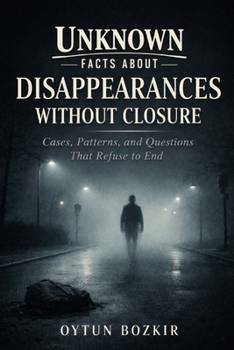
Unknown Facts About Disappearances Without Closure: Cases, Patterns, and Questions That Refuse To End

Some disappearances end with answers. Others do not. They leave no body, no confirmed explanation, and no final moment that allows the story to close. These are not simply unsolved cases-they are unresolved realities.
Unknown Facts About Disappearances Without Closure explores the disappearances that resist conclusion, not because no one searched, but because certainty itself collapsed under time, contradiction, and systemic limits. Drawing on investigative patterns rather than sensational cases, this book examines why some vanishings remain permanently open-legally, psychologically, and existentially.
Across thirty long-form chapters, Oytun Bozkır analyzes the structures that sustain unresolved disappearance: investigations that narrow too early, witnesses whose memories fracture reality, borders and transit zones where responsibility dissolves, oceans and skies that erase evidence, cities that monitor everything yet explain nothing, and media narratives that replace facts with coherence. The book also confronts the human cost-families suspended between hope and mourning, societies uncomfortable with ambiguity, and institutions built to close files rather than confront uncertainty.
This is not a true-crime collection, and it does not promise hidden revelations. Instead, it asks a more difficult question: what happens when closure is not delayed, but impossible? What does it mean to live in a world where some stories never end?
Written in a restrained, analytical tone, Unknown Facts About Disappearances Without Closure is a study of absence itself-how it persists, how it reshapes memory and meaning, and how modern systems struggle when answers refuse to arrive.
For readers drawn to unexplained phenomena, investigative psychology, and the limits of knowledge, this book offers not solutions, but clarity about why some mysteries remain forever unfinished.
Customer Reviews
ThriftBooks® and the ThriftBooks® logo are registered trademarks of Thrift Books Global, LLC
