


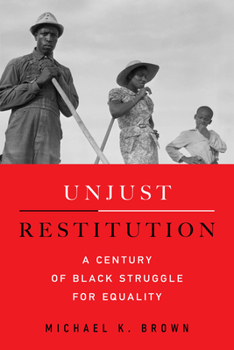
Unjust Restitution: A Century of Black Struggle for Equality
No Customer Reviews

Select Format
Select Condition 
Book Overview
The question of economic justice for Black Americans continues to be the subject of contentious political debate. Here, Michael K. Brown examines the meaning of racial equality during three transformative periods when economic opportunity appeared to be a real possibility: Reconstruction, the New Deal, and the Great Society. Political leaders who believed slavery and Jim Crow degraded Black people enacted policies to rehabilitate formerly subjugated individuals. Black Americans, on the other hand, repudiated the idea that they were damaged people in need of repair. Repeatedly, Black people's vision of economic justice was based on antiprivilege egalitarianism, the idea that a just restitution for their oppression required abolishing the political and legal privileges whites had acquired. Black opposition reveals what was at stake at each historical moment and what might constitute economic justice in the twenty-first century.
Format:Paperback
Language:English
ISBN:0520410114
ISBN13:9780520410114
Release Date:February 2025
Publisher:University of California Press
Length:344 Pages
Weight:1.00 lbs.
Dimensions:1.0" x 6.0" x 8.9"
Customer Reviews
0 rating
Copyright © 2026 Thriftbooks.com
Terms of Use | Privacy Policy | Do Not Sell/Share My Personal Information | Cookie Policy | Cookie Preferences | Accessibility Statement
ThriftBooks ® and the ThriftBooks ® logo are registered trademarks of Thrift Books Global, LLC
ThriftBooks ® and the ThriftBooks ® logo are registered trademarks of Thrift Books Global, LLC
